Switzerland is building a giant underground battery.
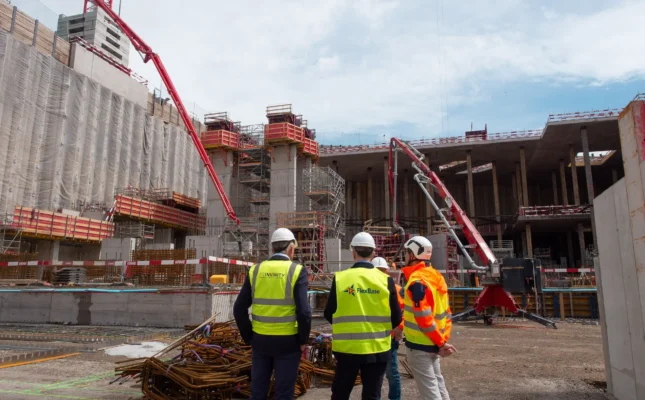
A project that could change the way energy is stored in Europe is being developed in Laufenburg, Switzerland. Tens of meters underground, a massive flow battery is being built with a planned capacity exceeding 2.1 GWh. Its developers claim that in terms of power output, it could be comparable to the country’s largest nuclear power plant.
However, the most important aspect is not its record-breaking specifications. The investment addresses one of the biggest challenges of the energy transition: how to ensure stable electricity supply when solar and wind power is generated depending on weather conditions, rather than demand.
A Giant Battery Hidden Underground
The project is being developed by FlexBase in the canton of Aargau, near the famous “Laufenburg Star” — a historic hub connecting Europe’s power grids.
Construction of the technology campus began in spring 2025. It will include not only energy storage systems, but also an AI-powered data center, research laboratories, and office space.
The scale of the project is impressive. The underground section is being built in an excavation about 27 meters deep and longer than two football fields. This is where the key components of the energy storage system will be installed.
The entire campus will cover over 40,000 m², while the storage facility itself will occupy around 20,000 m², making it far larger than typical battery installations.
What Are Flow Batteries?
Most people associate energy storage with lithium-ion batteries used in phones, laptops, or electric vehicles. The technology used in Laufenburg is fundamentally different.
A flow battery stores energy in special liquids contained in large tanks. During charging, electrical energy is converted into chemical energy stored in an electrolyte. When electricity is needed, the process is reversed.
One of the key advantages of this technology is scalability: storage capacity can be easily increased by expanding the tanks, making it more flexible than traditional lithium-ion systems.
FlexBase also emphasizes safety. The electrolyte is water-based, making it non-flammable and non-explosive—an important factor for a project of this scale.
British Technology Provider Involved
A key milestone in the project was the announcement of cooperation with Invinity Energy Systems, one of the global leaders in vanadium flow battery technology.
The first phase of the project will include up to 1.5 GWh of storage capacity. In later stages, the system will be expanded to more than 2.1 GWh.
According to FlexBase, safety, long lifespan, and flexibility were the main reasons for choosing Invinity’s technology.
More Than Just an Energy Storage Facility
Laufenburg is designed to be more than just an energy infrastructure project. It will combine energy storage with an AI-driven data center.
Interestingly, the heat generated by servers will not be wasted. It is planned to be fed into the local district heating network, supplying energy to residents of Laufenburg and nearby areas.
The project is expected to reduce CO₂ emissions by nearly 75,000 tons over 30 years.
A Multi-Billion Investment
The total cost is estimated at between 1 and 5 billion Swiss francs (approximately 4.5–22 billion PLN). The project will be privately financed and is expected to create around 300 jobs.
A Glimpse of the Future of Energy
Although full commissioning is planned for the end of the decade, the Laufenburg project already illustrates the direction European energy systems are heading.
The energy transition is no longer just about building more wind and solar farms. Increasingly, it is about technologies that store energy when there is surplus and release it when demand is high.
If successful, the underground battery in Switzerland could become a model for similar projects across Europe — including countries that are rapidly expanding their renewable energy capacity.
Leave a Reply