A German project is studying DC-coupled energy storage systems.
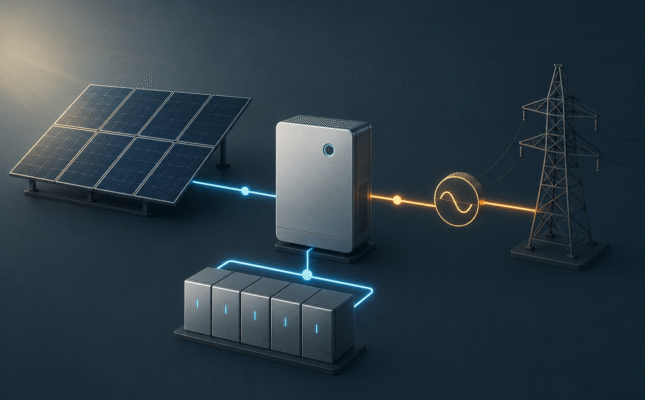
A German pilot project in the town of Widderstall is investigating whether commercial energy storage systems coupled on the DC side could become a key enabler for building larger photovoltaic installations in areas with limited grid connection capacity. The innovative initiative, carried out jointly by technology company Sigenergy, energy utility EnBW, and the Centre for Solar Energy and Hydrogen Research Baden-Württemberg, aims to assess how this technology can reduce material usage, improve overall system efficiency, and simplify grid procedures.
Eliminating unnecessary inverters and enabling direct charging
The tested system has a capacity of 252 kWh and is based on advanced hybrid inverters, the Sigen Hybrid 60 M1-HYA, supplied by Sigenergy. These devices enable a direct DC-coupled connection between photovoltaic panels and batteries, significantly reducing the amount of required power electronics compared to traditional AC-coupled systems.
In a conventional AC architecture, if a 100 kW solar installation is connected to a grid with a limited 50 kW export capacity, the investor must install 100 kW of solar inverters plus an additional 50 kW battery inverter, along with software export limitations.
With DC coupling, both functions are handled by a single 50 kW hybrid inverter. When solar panels produce 100 kW, the inverter converts 50 kW for grid export while the remaining 50 kW is directly stored in the battery on the DC side. This eliminates the need for a separate battery inverter entirely.
Overcoming regulatory barriers and adapting to new legislation
Project participants note that AC-coupled systems have historically dominated the commercial storage market. However, the industry is increasingly recognizing that operating on DC is not only safe but also significantly more energy efficient. Traditional grid constraints have often forced developers to downsize PV installations to match connection limits. DC coupling allows much better use of existing infrastructure, enabling larger solar plants without increasing grid connection capacity.
The Widderstall pilot also addresses regulatory challenges. The partners are testing hybrid operating modes in which batteries are charged not only from onsite solar generation but also directly from the grid during low-price periods. This is particularly relevant in the context of Germany’s upcoming regulatory framework known as “MiSpeL”, which aims to define how stored energy is attributed to renewable or grid sources.
In the current draft, DC-coupled systems are excluded from the most flexible accounting rules in favor of a simplified allocation model. The consortium aims to demonstrate through its tests that DC-side metering can precisely distinguish between renewable and grid electricity, potentially convincing regulators to adapt the rules in favor of the new technology.
Leave a Reply