45 GW of new energy storage. The EU has signed a historic agreement
The European Commission, EU member states and representatives of the energy sector have signed the first‑ever tripartite agreement on the development of energy storage. The document sets specific targets for the years 2026–2028 and is intended to become one of the pillars of Europe’s energy transition and efforts to strengthen industrial competitiveness.
The agreement is a response to the growing importance of energy storage in a power system based on renewable energy sources. The European Commission points out that without rapid development of storage technologies, further expansion of photovoltaics and wind power will become increasingly difficult, and the operating costs of the system will rise.
Ambitious target
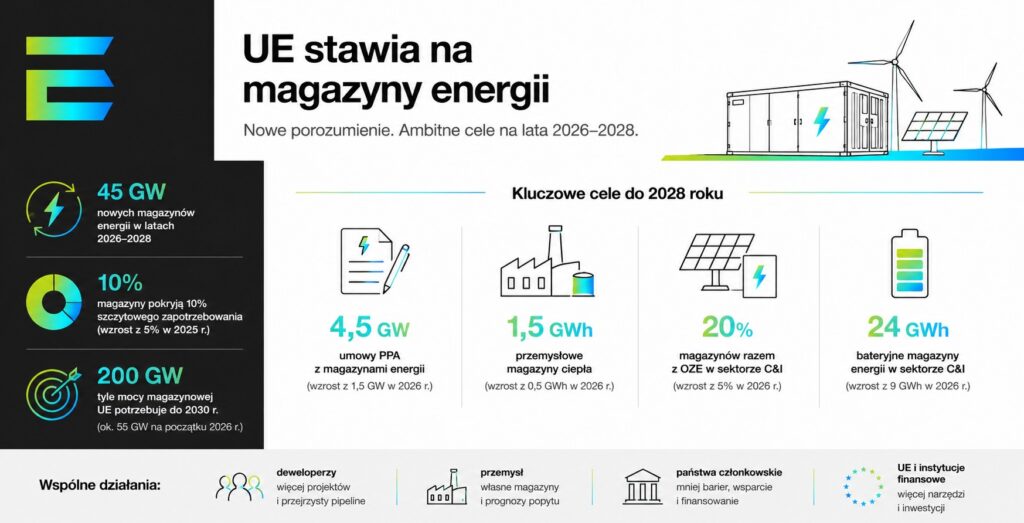
One of the most important provisions of the agreement is the commitment to increase the pace of energy‑storage deployment by at least 20% compared to 2025 levels. This means the creation of approximately 45 GW of new storage capacity between 2026 and 2028.
This is an important step toward achieving the European Union’s long‑term plans. According to the Commission, around 200 GW of installed storage capacity will be needed by the end of the decade, while at the beginning of 2026 only about 55 GW of such installations were in operation. Achieving this goal will require the use of multiple technologies – from battery energy storage systems (BESS), through pumped‑storage hydropower and thermal storage, to flow batteries and hybrid projects integrated with renewable energy sources.
Storage systems to reduce gas consumption
The European Commission assumes that the development of energy storage will enable better use of renewable‑energy production, reduce curtailment, and decrease dependence on imported fossil fuels.
One of the main indicators will be increasing the share of energy storage in covering peak electricity demand from around 5% in 2025 to 10% in the coming years. According to the authors of the document, this will translate into lower natural‑gas consumption, more stable energy prices, and reduced operating costs for the entire power system.
Industry will also receive new impulses
The agreement covers not only the energy sector but also industrial enterprises.
By 2028, the following targets have been set:
- increase PPA contracts linked to energy storage from 1.5 GW to 4.5 GW,
- triple industrial thermal‑storage capacity from 0.5 GWh to 1.5 GWh,
- increase the share of storage systems installed together with renewable energy from 5% to 20% of all new commercial and industrial RES installations,
- increase battery‑storage capacity used by enterprises from 9 GWh to 24 GWh.
Concrete commitments for all parties
The document clearly defines the responsibilities of each participant in the agreement.
Energy‑storage developers will present annual forecasts of new investments, improving market predictability and facilitating grid‑development planning. Energy‑intensive industries have committed to implementing their own storage projects and providing forecasts of future electricity demand.
Member states are expected to accelerate the removal of regulatory barriers hindering storage development, support long‑term PPA contracts, and create transparent rules for compensating services provided by storage systems. Additionally, the agreement allows the use of national and EU financial instruments to support storage projects and component manufacturing.
The Commission will prepare new support instruments
The European Commission has committed to developing additional measures to support investments.
Planned actions include:
- assisting member states in designing support schemes,
- faster procedures for approving state aid,
- supporting industrial decarbonization through the Industrial Decarbonisation Bank,
- including energy storage in future Innovation Fund auctions,
- updating network codes to facilitate grid connections for storage systems,
- analyzing changes to the EU Taxonomy regarding public‑investment financing for energy‑storage projects.
Increased financial support
European financial institutions are expected to play a key role in implementing the agreement.
The European Investment Bank plans to expand support programs for manufacturers of storage‑system components and investment projects. Consideration is also being given to including energy storage in guarantee schemes for corporate PPAs and using equity and debt instruments to support the development of European storage technologies. Additional funding has also been announced by the European Bank for Reconstruction and Development, which will support both investments and regulatory development in member states.
Energy storage becomes a strategic element of the transition
The new agreement highlights a shift in the European Union’s approach to the energy transition. While a few years ago the main focus was on expanding renewable energy sources, today the equally important element is building a flexible energy‑storage system.
The European Commission assumes that implementing the provisions of the agreement will create a more predictable investment market, increase energy security, reduce power‑system operating costs, and strengthen the European industry producing energy‑storage technologies. Progress will be monitored annually until the end of 2028 based on indicators such as new storage capacity, the share of storage in covering peak demand, the number of PPA contracts, and the development of industrial energy‑storage systems.
Leave a Reply