Szczecin is building its own local energy loop. This is what urban energy transformation looks like in practice
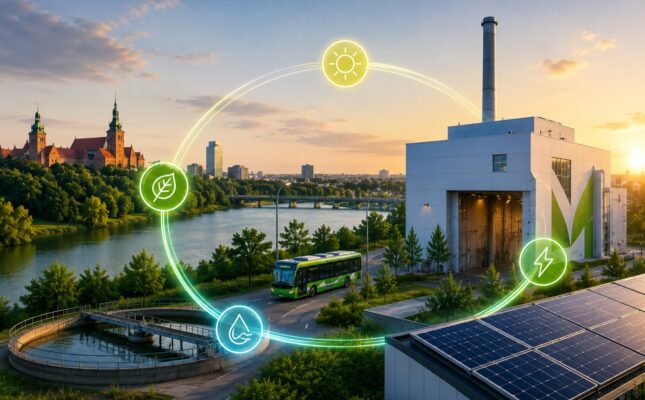
Szczecin od kilkunastu lat konsekwentnie rozwija własny model bezpieczeństwa energetycznego. Miasto inwestuje zarówno w stabilne źródła energii, jak i odnawialne instalacje rozproszone, tworząc lokalny miks energetyczny, który ogranicza emisje, zwiększa niezależność i obniża koszty funkcjonowania miejskich jednostek.
Artykuł jest fragmentem kompendium „Niezależność energetyczna – polska transformacja rozpoczyna się oddolnie”, przygotowanego przez redakcję e-magazyny.pl we współpracy z naukowcami i ekspertami branży. W publikacji znajdziesz więcej przykładów dobrych praktyk oraz analiz dotyczących transformacji energetycznej w Polsce.
From the first PV installations to a municipal energy mix
The history of municipal self‑generation in Szczecin began during the EU’s 2007–2013 financial perspective. The first step was photovoltaic installations, which were later complemented by additional energy sources.
Today, the city’s system includes:
- photovoltaic installations,
- gas generators using biogas from wastewater treatment plants,
- a small hydropower plant with a Francis turbine,
- the “EcoGenerator” Waste‑to‑Energy Plant, operating in high‑efficiency cogeneration.
It is EcoGenerator that has become the foundation of the entire system. The installation simultaneously produces electricity and heat used in the municipal district‑heating network. Waste heat covers around 15% of the district‑heating demand, while electricity powers key municipal infrastructure.
How does the municipal energy loop work?
One of the first entities to develop self‑generation was the Water and Sewage Company (ZWiK).
Energy is produced from several complementary sources:
- biogas generated at the Pomorzany and Zdroje wastewater treatment plants,
- a small hydropower plant with a Francis turbine at the Pomorzany Water Production Plant,
- photovoltaic farms owned by ZWiK,
- electricity generated by EcoGenerator.
The produced energy supplies, among other things:
- street lighting and traffic signals,
- around 30% of Tramwaje Szczecińskie’s electricity demand,
- Technopark Pomerania,
- infrastructure for charging electric buses.
Thanks to this, energy remains within the municipal system and flows where it is most needed.
The Francis turbine – a small installation with big significance
A particularly interesting element of the system is the Francis turbine operating at the Pomorzany Water Production Plant.
Instead of passively reducing excess pressure in the water network, the installation uses it to generate electricity.
Key parameters:
- power: 132 kW,
- annual production: approx. 744 MWh,
- very low operating costs,
- no local emissions.
The generated energy is consumed directly by the water plant — powering pumps, water‑treatment processes, UV installations and automation systems. This increases self‑consumption and stabilizes the facility’s energy‑use profile.
Photovoltaics as part of a larger system
In parallel, Szczecin is developing municipal photovoltaic installations.
Solar panels have already been installed on:
- schools,
- nurseries,
- sports facilities,
- cultural institutions,
- Water and Sewage Company facilities.
In total, 46 micro‑PV installations are in operation.
Older installations operate under net‑metering, while new ones are designed for maximum self‑consumption and net‑billing principles. This means that energy is produced primarily where it is consumed during the day, instead of being fed into the grid.
As a result, photovoltaics become an integral part of the municipal energy system rather than just an add‑on to public buildings.
Energy balance – the numbers show the scale
Total electricity production from all municipal sources amounts to around 87.6 GWh per year.
The largest producer remains EcoGenerator, supplying around 68,600 MWh of electricity annually and providing around 15% of heat for the district‑heating network.
The second pillar of the system is the Water and Sewage Company installations, with total production exceeding 8,900 MWh per year.
Additional energy is supplied by PV farms and micro‑installations located on municipal buildings.
With annual electricity demand of municipal units and companies exceeding 100 GWh, local production can cover a significant share of the city’s electricity needs. In practice, this share depends on real‑time demand and the system’s balancing capabilities.
The most important aspect, however, is that energy reaches consumers of strategic importance for the functioning of the city.
Energy stays in the city
Szczecin is developing not only energy infrastructure but also an energy‑management model. After obtaining a license to trade electricity, EcoGenerator can participate in tenders for supplying energy to municipal units and companies. This ensures that locally produced energy remains within the municipal system instead of flowing exclusively into the national grid.
This approach:
- shortens the path from producer to consumer,
- increases the use of local energy,
- improves predictability of energy‑purchase costs,
- strengthens the city’s energy security.
Next stage: energy storage and new renewable sources
The city plans further expansion of the system.
In the coming years, the following are planned:
- new PV installations designed for self‑consumption,
- further development of ZWiK’s energy sources,
- pilot energy‑storage systems,
- analysis of potential sites for wind‑energy development.
The goal is to better match energy production to real demand and increase the level of local energy independence.
Szczecin shows what modern urban energy can look like
The model developed in Szczecin demonstrates that municipal energy transformation does not have to rely solely on renewable energy sources. The key is the right combination of stable base‑load sources with distributed RES installations and using energy where it is most needed.
It is an example of a gradually built municipal energy loop in which production, distribution and consumption form a coherent system that increases energy security and improves the efficiency of city operations.