These are no longer ordinary battery systems. Grid‑forming is changing the rules of the game
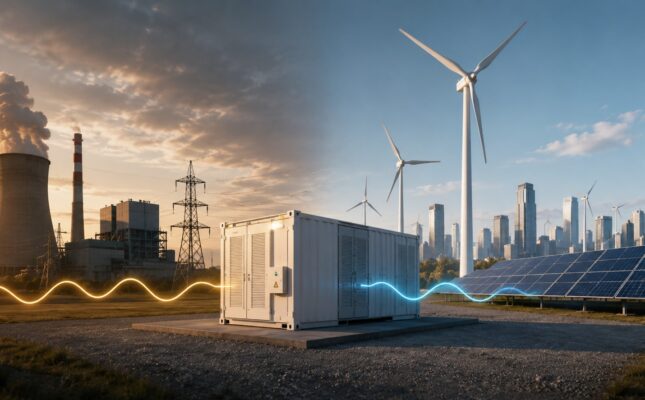
A few years ago, energy‑storage systems were viewed primarily as devices used to store surplus electricity and increase self‑consumption of renewable energy. However, with the rapid development of wind and solar power, their role has begun to evolve quickly. Today, energy‑storage systems are no longer just “system batteries”; they increasingly act as active elements responsible for maintaining the stability of national power systems.
The energy transition is causing a fundamental change in how power grids operate. The traditional model relied on large synchronous power plants — coal, gas, hydro, or nuclear — whose rotating generators provided natural system inertia. For decades, this inertia stabilized frequency and voltage and cushioned the impact of sudden disturbances.
Today, the situation looks completely different. A growing share of energy is supplied by sources using power electronics — photovoltaic farms, wind power plants, and energy‑storage systems. They do not have classic synchronous generators, and therefore do not provide natural system inertia. As a result, grid operators must increasingly look for new methods to maintain the stability of the power system.
The answer to this challenge is grid‑forming technology, now considered one of the most important directions in modern power‑system development. Experts point out that without widespread deployment of grid‑forming inverters, achieving a power system based almost entirely on renewable energy will be extremely difficult. Work on technical requirements and standardization is already underway at both national and European levels.
Why the current model is no longer enough
For more than a century, the power system developed according to relatively simple principles. Energy was produced in large, central power plants and then transmitted to consumers. Most generating units were synchronous machines equipped with heavy rotors spinning at a speed corresponding to grid frequency.
Their kinetic mass played a crucial role. In the event of a sudden increase in demand or a system failure, the energy stored in the rotating masses was temporarily released into the grid, slowing frequency changes. Operators gained valuable time to activate appropriate control mechanisms.
With the growth of renewable energy sources, however, the number of operating synchronous generators is steadily decreasing. Photovoltaic plants produce energy as direct current, which is converted to alternating current only through inverters. Wind power plants also increasingly use power‑electronic systems decoupled from grid frequency.
The consequence is a decline in system inertia. Even small disturbances can cause much faster frequency changes than a decade ago. This phenomenon is already observed in many European countries where the share of renewables periodically exceeds 70–80% of energy production.
The problem is not that renewable sources are less stable. The challenge arises because the modern system architecture requires new mechanisms to provide system services that were previously an “automatic by‑product” of conventional power‑plant operation.
Grid‑following — the technology that dominates today
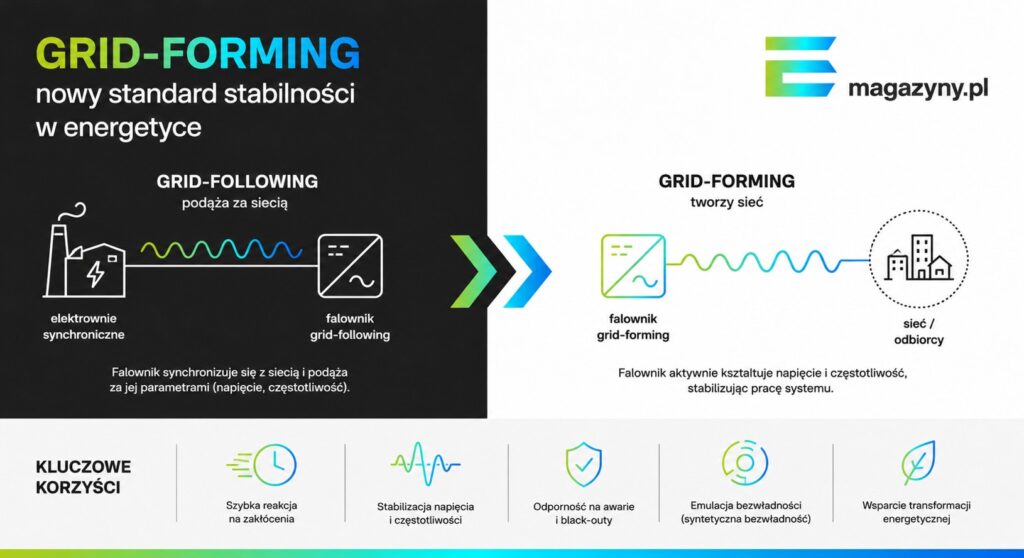
Most inverters installed today operate in a mode known as grid‑following. Their task is to observe the parameters of the existing power grid. The inverter analyzes frequency and voltage, synchronizes with them, and then injects the appropriate amount of energy into the grid. This works perfectly when the system still has enough classical synchronous power plants. They “set the rhythm,” and the inverters simply follow it.
It can be compared to an orchestra. The conductor sets the tempo, and the musicians follow his cues. The problem arises when the conductor disappears. Musicians who can only follow instructions cannot maintain a common tempo on their own.
Classic grid‑following inverters behave similarly. When the system becomes very weak or a major disturbance occurs, these devices cannot independently stabilize grid parameters. This is one of the reasons why renewable‑energy development requires the next technological step.
Grid‑forming — an inverter that creates the grid
Grid‑forming technology reverses the traditional operating philosophy. Instead of merely synchronizing with the existing grid, the inverter itself becomes a source of voltage and frequency. This means it actively participates in shaping the operating parameters of the power system. In practice, the device behaves similarly to a synchronous generator, even though it is not one physically. Thanks to advanced control algorithms, it can react to load changes in fractions of a second, stabilize voltage and frequency, and even emulate inertia through synthetic inertia.
This is why grid‑forming is often described as the next stage in the evolution of power electronics. It is no longer just about converting electricity — it is about actively co‑creating a stable power system.
Research conducted by transmission‑system operators, research institutes, and ENTSO‑E indicates that grid‑forming technologies will be essential for power systems with very high shares of renewable energy. At the same time, European technical requirements and certification procedures for such devices are being developed.
System services – a new source of value for energy‑storage systems
For many years, the profitability of energy‑storage investments was analyzed primarily through the lens of price arbitrage — buying electricity during low‑price periods and selling it during peak hours. For businesses, increasing self‑consumption from photovoltaic installations, reducing contracted capacity, and lowering penalties for exceeding power limits were also important.
Although these models remain relevant, revenues from providing system services are becoming increasingly significant. Power‑system operators need assets capable of reacting instantly to changes occurring in the grid, and energy‑storage systems are among the fastest technologies available.
Unlike conventional power plants, which may require several to dozens of minutes to start up or change output, energy‑storage systems can reach full power almost immediately. In many cases, the response is measured in milliseconds or single seconds. This makes them exceptionally well suited for system‑stabilizing services.
Frequency regulation
One of the most important parameters of a power system is frequency, which in Europe is 50 Hz. Even small deviations from this value may indicate an imbalance between electricity production and consumption.
If demand suddenly increases, frequency begins to fall. Excess production causes it to rise. Operators must keep frequency as close as possible to its nominal value, because prolonged deviations can trigger automatic shutdowns of generating units or consumers.
Energy‑storage systems equipped with appropriate control systems can inject energy into the grid or begin charging almost instantly. As a result, they support balancing supply and demand much faster than most conventional generation sources.
Voltage regulation
Another key area is maintaining proper voltage levels. With the growth of distributed renewable sources, operators increasingly observe local issues with voltage exceeding permissible limits, especially in distribution networks.
Grid‑forming inverters can actively manage reactive power and stabilize voltage in real time. In practice, this means improving power quality without costly grid‑infrastructure upgrades.
Synthetic inertia – the digital equivalent of rotating masses
One of the most frequently discussed concepts in the future of power systems is synthetic inertia, also known as virtual or digital inertia.
Classic synchronous power plants have massive rotors weighing hundreds of tons. The energy stored in their rotational motion acts as a natural buffer — slowing frequency changes and giving operators time to take stabilizing actions.
Energy‑storage systems do not have rotating elements, but with properly programmed algorithms they can mimic the behavior of synchronous generators. When a sudden frequency drop is detected, the inverter immediately increases power output; when frequency rises, it intensifies charging.
Although this phenomenon is not physical inertia in the traditional sense, the effect on system operation can be very similar. This is why the development of synthetic‑inertia technology is considered one of the pillars of future power systems based on renewable energy.
Grid‑forming and power‑system resilience
The growing number of extreme weather events, cyber threats, and rapid electrification of the economy make the resilience of energy infrastructure increasingly important.
Until recently, energy security was associated mainly with having sufficient generation capacity. Today, the ability of the system to maintain stable operation despite disturbances is equally crucial.
Grid‑forming technology fits this philosophy. Intelligent inverters not only react to changes in grid parameters but can also actively prevent disturbances from spreading. This reduces the risk of a domino effect, where a local failure triggers additional shutdowns across the system. Overall, it means greater resilience for both national power systems and local distribution networks.
Microgrids – the future of distributed energy
One of the most promising applications of grid‑forming technology is microgrids — local energy systems capable of operating independently. A microgrid may include an industrial facility, a university campus, a hospital, a logistics center, an airport, a port, or even a small town. Under normal conditions, it cooperates with the national power grid, but in the event of a failure it can disconnect and operate autonomously.
To make this possible, there must be a source that takes over the role of stabilizing frequency and voltage. Traditionally, this function was performed by diesel generators or small gas power plants.
Increasingly, however, this role is being taken over by energy‑storage systems equipped with grid‑forming inverters. They allow the creation of a local “energy island” in which energy from photovoltaic installations, wind turbines, and other renewable sources can be used even when the national grid is offline.
Such solutions are used wherever continuity of supply is critical — in hospitals, data centers, industrial plants, or critical infrastructure. As distributed energy continues to grow, the number of such projects is expected to increase steadily.
Black start – energy‑storage systems as a tool for restoring the power system
One of the most advanced applications of grid‑forming technology is the ability to perform black‑start services — restoring the power system after a complete loss of voltage. In the traditional model, system restoration begins with starting selected power plants equipped with their own auxiliary power sources. Then, step by step, transmission lines, substations, and generating units are brought back online. This process is complex, requires strict coordination by the transmission‑system operator, and can take several to even a dozen hours depending on the scale of the outage.
The growing share of renewable energy sources means that the classical restoration model is no longer the only viable solution. Energy‑storage systems equipped with grid‑forming inverters can independently generate a stable reference voltage, energize a local network, and gradually synchronize additional energy sources.
In practice, this means the ability to restore parts of the power system without waiting for large conventional power plants to start up. This becomes particularly important in distributed energy systems where a significant share of capacity comes from photovoltaic installations, wind farms, and energy‑storage systems.
Although black‑start services provided by energy‑storage systems are still at the pilot‑deployment stage in many countries, transmission‑system operators increasingly include them in their development strategies. The reason is simple — a battery reaches full power almost instantly, while starting a conventional power plant takes significantly more time.
Europe prepares its grid for the era of energy storage
The rapid development of grid‑forming technology is no coincidence. It is a response to changes occurring in European power systems, where the share of renewable energy sources grows year by year.
In many EU countries, there are already periods when wind and solar energy cover the vast majority of national demand. This means that the number of operating synchronous generators is steadily decreasing, and responsibility for maintaining grid stability is gradually shifting to power‑electronic devices.
European institutions responsible for energy‑market development recognize this trend. Transmission‑system operators, inverter manufacturers, research units, and industry organizations are working intensively on developing common technical requirements for grid‑forming devices. The goal is to ensure interoperability between solutions from different manufacturers and to create unified certification rules.
A key challenge is also the proper remuneration of services provided by energy‑storage systems. Many countries are developing new market mechanisms that will allow storage owners to earn revenue not only from selling energy but also from providing services that stabilize the power system.
Poland is at the beginning of this journey
The Polish energy‑storage market is currently developing faster than ever before. Just a few years ago, most installations were demonstrative or pilot‑scale. Today, projects with capacities measured in hundreds of megawatts are being implemented, and more investments are in preparation.
Several factors support market growth. The first is the rapidly increasing number of renewable‑energy installations, especially photovoltaics. The second is the growing frequency of generation curtailments and challenges with connecting new sources to the grid. The third is changes in the energy market that increase the value of flexible assets capable of responding quickly to system needs.
At the same time, it should be noted that most current investments focus on basic energy‑storage functions such as price arbitrage, participation in the balancing market, or providing regulatory services. Grid‑forming technologies are only beginning to appear in the specifications of new projects.
However, it is likely that within the next few years they will become one of the fundamental requirements for the largest battery installations. As the share of renewable energy increases, operators will expect new storage systems not only to store energy but also to actively support the operation of the power system.
New business models for investors
The development of grid‑forming technology also changes how the economics of energy‑storage systems are perceived. Until recently, investors primarily analyzed the difference between the purchase and sale price of electricity. Today, the ability to combine multiple revenue streams within a single project is becoming increasingly important.
An energy‑storage system can simultaneously increase self‑consumption from a photovoltaic installation, reduce grid power intake during peak hours, participate in the balancing market, provide frequency‑regulation services, and — in the future — deliver advanced system services based on grid‑forming technology.
This approach is known as value stacking, meaning the layering of different revenue streams. The broader the range of functions a storage system can perform, the greater its economic value and resilience to changing market conditions. This multifunctionality is precisely why energy‑storage systems are increasingly viewed not as infrastructure costs but as system assets generating revenue throughout their operational lifetime.
Technological and regulatory challenges
Although grid‑forming technology is developing rapidly, its widespread deployment comes with several challenges. The first is the lack of unified technical requirements across European countries. Individual transmission‑system operators currently apply their own guidelines regarding inverter operating parameters, system‑service delivery, and testing procedures. This complicates the design of universal solutions and lengthens the certification process for new devices.
The second challenge is the creation of appropriate market mechanisms. For investors to be willing to bear the higher cost of advanced grid‑forming inverters, they must be able to obtain additional revenue for services that stabilize the power system. This requires further development of system‑service markets and regulatory adjustments to reflect the realities of a renewable‑based power system.
Cybersecurity is also crucial. Grid‑forming relies on advanced control algorithms and digital communication, meaning protection against cyberattacks will be a key element of its future development. As the number of energy‑storage systems grows, the importance of security measures increases — both at the level of individual installations and across the entire power‑system infrastructure.
Artificial intelligence and EMS systems
The development of grid‑forming technology will be closely linked to the growing use of artificial intelligence and advanced Energy Management Systems (EMS).
Modern energy‑storage systems already analyze weather forecasts, electricity prices, expected consumer demand, and grid conditions. In the coming years, algorithms will increasingly predict disturbances and optimize storage operation in real time. This marks a shift from reactive to predictive power‑system management.
In practice, an energy‑storage system will not merely respond to operator commands — it will be able to anticipate changes in grid parameters and prepare in advance to deliver system services. This approach will increase resource efficiency and reduce the operating costs of the entire power system.
Grid‑forming as a foundation of future energy systems
The energy transition is not only about replacing conventional power plants with renewable sources. It also means a complete shift in the philosophy of power‑system operation.
In the future, grid stability will not be ensured primarily by heavy rotating generators, but by intelligent power‑electronic devices working alongside energy‑storage systems, renewable sources, consumers, and digital management systems.
Grid‑forming is becoming one of the most important elements of this transformation. With its ability to independently shape voltage and frequency, emulate inertia, and support system restoration after failures, this technology enables the creation of power grids that are resilient to disturbances and prepared for further growth in renewable‑energy penetration.
For investors, this means entirely new business opportunities. An energy‑storage system is no longer merely a device for storing electricity — it becomes an infrastructure asset providing services of strategic importance for energy security.
The coming years will be a time of intense transformation for Poland. The rapid development of large‑scale energy‑storage systems, modernization of power‑grid infrastructure, and continued growth in renewable‑energy capacity will make grid‑forming technologies gradually become standard in new investments.
It is likely that within the next decade the question will no longer be whether energy‑storage systems should support power‑system stability, but how to best utilize their potential. In a world where electricity increasingly comes from non‑dispatchable renewable sources, intelligent energy‑storage systems equipped with grid‑forming capabilities may become one of the most important pillars of a secure, flexible, and low‑emission power system.
Sources:
- https://www.entsoe.eu/news/2021/04/01/grid-forming-capabilities-ensuring-system-stability-with-a-high-share-of-renewables
- https://www.entsoe.eu/news/2021/04/01/grid-forming-capabilities-ensuring-system-stability-with-a-high-share-of-renewables
- https://www.entsoe.eu/2025/01/23/entso-e-releases-the-latest-work-from-project-inertia-which-studies-the-evolution-of-the-inertia-levels-in-the-long-term-horizons-in-the-continental-europe-synchronous-area-and-the-challenges-emerging-from-their-decrease
- https://www.ise.fraunhofer.de/en/press-media/press-releases/2025/fraunhofer-ise-develops-test-procedure-for-grid-forming-inverters.html
- https://www.siemens-energy.com/global/en/home/products-services/product-offerings/grid-forming.html

Magdalena Pasik
Inżynier Gospodarki Wodnej oraz Inżynier Środowiska, absolwentka Uniwersytetu Przyrodniczego we Wrocławiu. Na co dzień – Specjalista ds. ochrony środowiska – w pracy zawodowej zajmuje się głównie emisją zanieczyszczeń do powietrza. Ochrona środowiska to nie tylko praca, ale przede wszystkim pasja.
Leave a Reply