Key decision on modular nuclear reactors. The Prime Minister says it will come this summer.
Prime Minister Donald Tusk has announced that the government will make a strategic decision on the development of medium‑sized small modular reactors (SMRs) later this summer. As he stated during Friday’s address, these solutions could play an important role in Poland’s energy transition, complementing traditional large‑scale nuclear power plants.
– Let’s address this quickly and conclude the proceedings regarding these state‑of‑the‑art medium modular nuclear reactors,” Tusk said, addressing Energy Minister Miłosz Motyka directly. I expect you to present a precise action plan on this matter by the end of the summer, he added.
The nuclear puzzle – not only large reactors
The Prime Minister’s remarks align with the government’s broader energy policy. Alongside ongoing preparations for the construction of Poland’s first large nuclear power plant, the government is also finalizing analyses for the second such facility. However, smaller modular reactors—potentially cheaper, faster to deploy and more flexible, especially near industrial sites or smaller urban areas—are increasingly becoming a central topic in recent political discussions.
OSGE and the BWRX‑300 technology
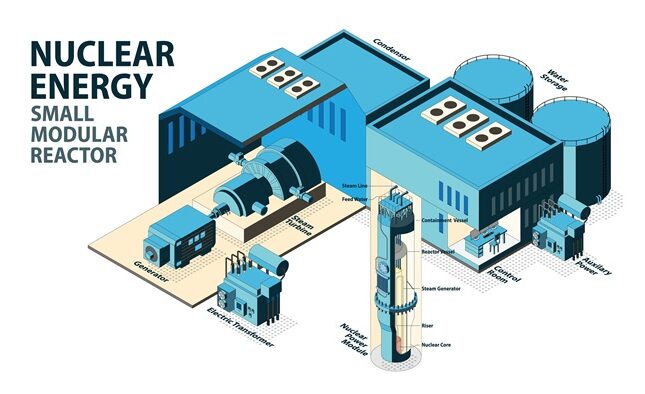
The most advanced SMR initiative in Poland is the project led by Orlen Synthos Green Energy (OSGE), a joint venture between PKN Orlen and Synthos, owned by Michał Sołowow. OSGE plans to deploy GE‑Hitachi BWRX‑300 reactors, part of the boiling‑water reactor family. These units have a capacity of 300 MWe and fall within the SMR category.
The first locations indicated by the investor include Włocławek, Ostrołęka and Stawy Monowskie near Oświęcim. In December 2023, the Ministry of Climate and Environment issued six Fundamental Decisions for the company, theoretically allowing the investment process to move forward.
Internal Security Agency raises concerns
However, SMR development in Poland has encountered significant administrative obstacles. It was revealed that during proceedings requiring an opinion from the Internal Security Agency (ABW), OSGE’s projects received a negative assessment. The company requested declassification of ABW’s justification to respond to it, but the request was denied.
In February 2024, the Ministry of State Assets announced an audit of OSGE conducted by the new management of Orlen. Additionally, the Ministry of Climate and Environment reported a review of the project’s ownership structure, stressing that it does not concern the BWRX‑300 technology itself.
This means that despite advanced preparations, further steps will require not only political approval but also resolution of national‑security concerns.
The Prime Minister pushes, but coherence is needed
Tusk’s statements should therefore be interpreted as a political signal—to both government administration and investors. A directional decision on SMRs, if indeed made this summer, could open the way for further investment, legislative and regulatory actions. It may also serve as a message to foreign technology partners that Poland is serious about deploying nuclear power in a modern, distributed form.
However, alignment between ministries and clarification of security issues will be essential. Without this, a technology already being tested and deployed in countries such as the United States and Canada may stall in Poland at the level of declarations.
Nuclear energy and climate policy
SMR development is part of a broader puzzle: meeting EU climate goals and strengthening energy security. Poland faces the need to move away from coal, reduce dependence on gas imports and ensure stable electricity supply amid rising demand.
While renewables play a key role, they cannot meet industrial and grid needs without support from stable sources. SMRs could serve as a bridge between centralised and distributed generation—supporting the energy mix while enabling power production closer to where demand arises.
What’s next?
The Prime Minister expects a concrete action plan from the Energy Minister by the end of the summer. By late September, we may see a document outlining the legal and financial framework for SMR deployment in Poland. The future of this technology in the country will depend on how detailed and realistic the plan is—and how it is received by the public and investors.
Source: portalsamorzadowy.pl
Leave a Reply