Financing energy projects, renewables and battery storage (BESS) – introduction to the article series

The energy transition is driving rapid growth in renewable energy and energy‑storage projects, making them one of the fastest‑expanding segments of the investment market. Rising demand for flexibility in the power system, the development of new generation capacity, hybridization of RES projects, and evolving regulations (such as UC84) mean that investors are increasingly seeking capital to implement such ventures. Access to both debt and equity financing is one of the fundamental conditions enabling project execution.
Financing energy projects is among the most demanding areas of investment finance. Banks, investment funds, leasing companies, and public institutions analyze not only the investor’s financial standing but also the project’s technical parameters, business model, projected revenues, regulatory risks, and the developer’s experience. Each type of financing has its own requirements, limitations, and project‑assessment criteria. Choosing the right financing structure can directly affect both the feasibility of the investment and its long‑term profitability — indirectly, through institutional requirements related to the business model, and directly, through financial terms.
Financing institutions expect well‑prepared projects, credible economic analyses, transparent documentation, and thorough risk assessments. In the case of RES and BESS projects, issues such as revenue forecasting, market volatility, and long‑term profitability become particularly important. This is why financing both large and small RES projects requires collaboration between specialists in finance, energy, law, and transactional advisory.
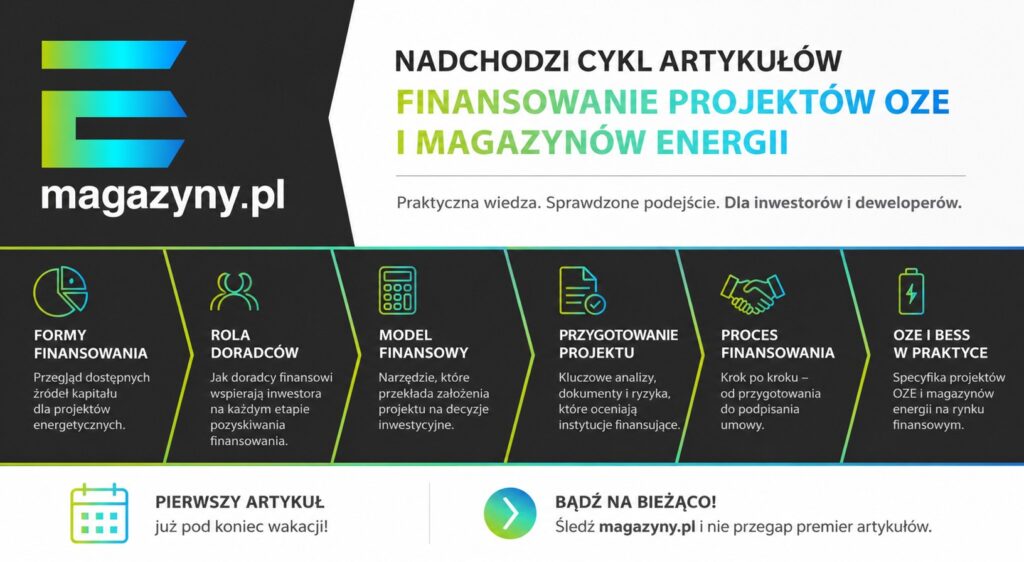
Recognizing market needs, we are launching a series of articles that will serve as a comprehensive guide to financing RES projects, with particular emphasis on energy storage. The financing methods and their characteristics presented in the series will be applicable to various types of energy projects, such as photovoltaic farms, wind farms, biogas and biomethane projects, hybrid installations, CHP plants, or gas‑fired installations, including gas peakers. The goal of the series is to present practical aspects of securing financing, preparing projects for discussions with financial institutions, financial modeling, and investment and transaction processes occurring in the energy market. The first article will be published at the end of the summer, and below we outline the topics that will be covered in the upcoming series.
What financing options are available for energy projects?
The first topic we will cover in this series concerns the financing options available on the market for energy projects. Depending on the characteristics of the investment, its scale, and its stage of development, various sources of capital may be used.
We will analyze project finance, which plays a key role in large infrastructure and energy projects and is based on the project’s ability to generate future cash flows. We will also discuss balance‑sheet/corporate financing and secured investment loans, commonly used by industry investors or in smaller projects. We will outline financing criteria and the benefits associated with each form of financing.
Special attention will be given to leasing and leasing‑based loans, which frequently appear in smaller energy projects, both standalone and those implemented within industrial facilities. We will also describe the potential use of private debt, green bonds, various types of bank guarantees and “green guarantees”, as well as other hybrid solutions created by financial institutions in response to market needs.
Among available financing sources, grants and preferential support programs also play an important role. Although they help reduce the cost of capital and improve investment profitability, they often come with additional obligations and limitations that are frequently overlooked at the application stage.
The role of advisors in the financing process
The high complexity of energy projects means that specialized advisory support is becoming increasingly important.
One of the key advisors in the financing process are financial advisors, also referred to as transaction advisors. We will describe their responsibilities and how transactional experience influences the effectiveness of securing capital. We will also explain what analyses an advisor prepares and how they support the investor at each stage of the financing process.
A financial advisor collaborates with other experts (technical, legal, etc.), often acting as a project manager. We will outline how the entire process unfolds step by step and how advisory support can shorten and streamline the project timeline.
The financial model as the foundation of investment decisions
One of the most important tools used to evaluate energy projects is the financial model, which translates technical and business assumptions into concrete economic and financial results. Based on the financial model, both investors and banks decide whether to engage in a project.
In a dedicated article on financial modeling for energy, RES, and BESS projects, we will present the structure of financial models, best practices for building them, the level of complexity required depending on the project, the scope of data, methods of obtaining it, and additional functionalities that allow for a thorough project assessment. We will outline different types of financial models and show how they can create value — demonstrating the opportunities offered not only by advanced project‑finance models but also by simplified models used for preliminary profitability assessments. We will also explain why a well‑prepared financial model is one of the most important elements evaluated by banks, investment funds, and equity investors, and how it helps optimize the project owner’s strategy.
The importance of price paths in RES projects
One of the biggest challenges for RES projects remains forecasting future revenues.
We will describe the importance of price paths, their impact on project bankability, and the ways in which energy‑price forecasts are used in financial models. We will also present the characteristics of price paths, estimated acquisition costs, and approaches to project‑specific forecasting (especially for BESS). Particular attention will be given to price paths and revenue forecasting for battery‑energy‑storage projects, while also highlighting analogies and differences in modeling other technologies and hybrid solutions.
From financing to project sale
The growth of the BESS and RES markets means that more and more projects are developed not only with the intention of operating them, but also with the goal of selling them later to a strategic or financial investor.
For this reason, the second part of our series will focus on M&A transactions and the trading of energy projects. We will present the role of an M&A advisor in the project‑sale process, discuss the importance of proper transaction preparation, and highlight the most common mistakes that affect project or asset value.
We will also show what a typical BESS project sale process looks like — from strategy development and preparation of information materials, through investor outreach, to due diligence, negotiations, and closing.
How investors value RES and BESS projects
One of the key issues for developers and project owners is the market value of their projects. In practice, valuation depends on many factors that go far beyond incurred investment costs.
In upcoming articles, we will analyze the impact of project status, grid‑connection conditions, legal status of the land, applied technology, cost structure, and regulatory risks on how investors perceive a project.
We will also discuss the differences between early‑stage projects and shovel‑ready projects, and how these differences influence investor interest.
The financial model in M&A processes
A financial model plays a crucial role not only in securing financing but also in project sales. For investors, it is one of the primary tools used to assess potential returns and quantify the impact of identified risks.
Within the series, we will explain the importance of the financial model in M&A processes, which assumptions undergo the most scrutiny, and how the model can influence negotiations and the final valuation. We will also outline the differences between a financing‑oriented model and an M&A‑oriented model, considering both sides of the transaction.
Offtake and its impact on project value
RES projects increasingly involve the issue of offtake, meaning contracts or mechanisms that ensure predictable revenues and reduce market‑exposure risks. These may include PPAs, RES auctions (CfD), capacity‑market auctions, or floor contracts for battery‑storage projects.We will present the specifics of offtake agreements for BESS projects, the process of securing them, and their impact on how financing institutions and potential investors evaluate a project.
A comprehensive guide to RES financing
We hope that the upcoming articles will help organize knowledge about financing, modeling, and transactions in the energy market, and will shed light on the practical aspects of implementing RES and energy‑storage projects. Our goal is to create a comprehensive knowledge base, as the RES market is maturing and requires increasing professionalization — and solid, structured, methodical knowledge can accelerate project delivery and help avoid many risks.

Artur Wronkowski – Managing Partner, ARIXO advisory
Artur Wronkowski is one of Poland’s most experienced financial and transaction advisors specializing in the renewable energy sector. He is the founder and Managing Partner of ARIXO advisory, a specialized financial and business advisory boutique serving the energy and infrastructure sectors.Artur’s: LinkedInhttps://www.linkedin.com/in/wronkowski

Jan Dworczak – Senior Analyst, ARIXO Advisory
An analyst specializing in financial modeling, economic analysis, and investment project financing. Jan has gained experience working on projects in the renewable energy and energy transition sectors, covering photovoltaic installations, energy storage, and hydrogen and biogas technologies.
ARIXO LinkedIn: https://www.linkedin.com/company/arixo-advisory
ARIXO Website:https://www.arixo.pl/
Leave a Reply