Energy storage boom in Europe. Investments are breaking records, and Poland is among the leaders.
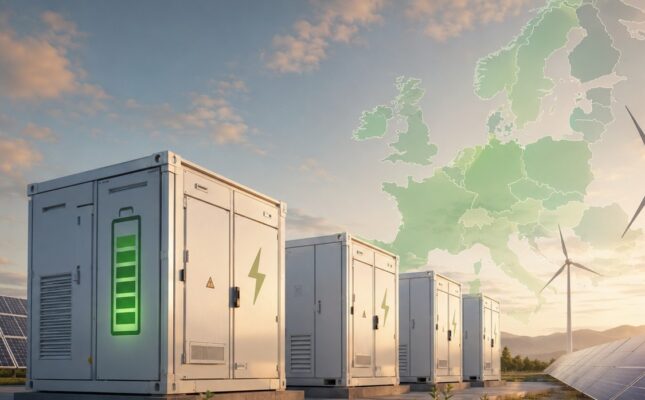
The European energy storage market is developing faster than ever before. According to Modo Energy, within just three months projects with a total capacity of 11 GW were announced, while disclosed financing exceeded €3 billion. Importantly, Poland is among the most active countries.
Europe’s energy transition is entering a new phase. While a few years ago the main focus was on building wind and solar farms, investors are now increasingly turning to energy storage systems. These are seen as a key solution to one of renewable energy’s biggest challenges—production intermittency.
European BESS in numbers
In the first quarter of 2026, 53 transactions involving energy storage projects were recorded in Europe. This is 50% more than in the previous quarter and the highest result in the history of the European market. The total capacity of projects covered by these transactions reached 11 GW, compared to 7.2 GW in the previous quarter.
The growing number of investments shows that energy storage is no longer just an add-on to renewable energy. It is increasingly becoming a standalone market segment, attracting infrastructure funds, banks, and major energy developers.
Germany leads, Poland among top markets
The highest number of transactions was recorded in Germany, which accounted for 13 projects—nearly one quarter of all announced investments.
It was followed by the United Kingdom, France, and Poland. Poland’s position is particularly notable, with four projects placing it among Europe’s leading markets.
This is another signal that the Polish energy storage market is gaining momentum, supported by public funding programs that help launch the first large-scale investments.
Investors focus on larger projects
The scale of projects is increasing quarter by quarter. In the first months of 2026, seven announced projects exceeded 500 MW of capacity.
The largest was a joint investment by PPC and Metlen in Southeastern Europe with a capacity of 1.5 GW. Close behind was FRV’s Spanish portfolio of 1.2 GW and Low Carbon’s UK portfolio of 1 GW of energy storage.
This growing scale shows that energy storage is becoming one of the most important areas of European energy development.
Solar PV and storage increasingly combined
One of the key trends is the growing number of hybrid projects combining solar farms with energy storage systems. While standalone storage projects used to dominate, developers are now increasingly choosing hybrid models.
The reason is simple: in many European countries, solar farms generate most electricity at the same time, which lowers wholesale prices. Storage systems allow energy to be saved and sold when it is most needed and most valuable.
Another factor is the limited availability of new grid connections, which encourages investors to maximize the use of existing infrastructure.
Over €3 billion in financing
The rapid market expansion is also attracting significant capital. In the first quarter alone, debt transactions worth approximately €3.1 billion were disclosed.
The largest financing was secured by Enerparc, which obtained a €1 billion package for projects in Germany, France, and Spain. Hundreds of millions of euros also went to projects in the UK and Italy.
However, experts note that the actual value of investments dedicated purely to energy storage is somewhat lower, as some financed portfolios also include solar PV assets.
Just the beginning
Rising renewable generation, the growth of electromobility, and the need to stabilize energy systems mean that the importance of energy storage will continue to grow rapidly.
All signs suggest that after a record-breaking start to 2026, the BESS sector will remain one of the hottest segments of Europe’s energy transition—and Poland has a chance to play a significantly larger role than just a few years ago.