China has launched the world’s first underwater data center powered by wind energy.
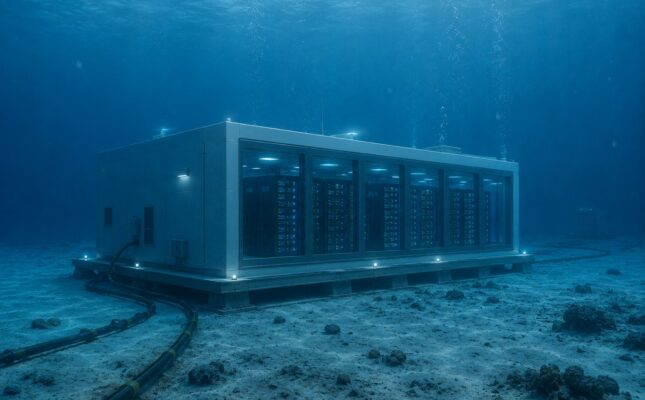
Off the coast of Shanghai, the world’s first underwater data center powered by electricity from an offshore wind farm has begun operations. The investment marks another step in China’s push to build more energy-efficient digital infrastructure designed to meet the rapidly growing demand for computing power driven by artificial intelligence.
The pilot project, Shanghai Lingang Undersea Datacentre, was launched in May 2026. It has a capacity of 24 MW and was developed in cooperation between HiCloud Technology and the state-owned China Communications Construction.
The data center is located about 10 kilometers off the Shanghai coast, at a depth of 10 meters below sea level. Electricity is supplied by a nearby offshore wind farm, significantly reducing the facility’s overall carbon footprint.
Cooling the servers using seawater instead of air conditioning
One of the biggest challenges for data centers is cooling. In traditional land-based facilities, cooling systems can account for 25–40% of total electricity consumption.
In the underwater data center, this challenge is partially solved by using the natural cooling properties of seawater. The stable ambient temperature reduces the need for additional cooling systems, resulting in lower energy consumption. According to Chinese authorities, the new installation uses over 20% less energy than comparable land-based facilities.
Responding to growing AI demand
Data centers are a fundamental part of the modern digital economy and the development of artificial intelligence. As the number of AI models and computing workloads increases, so does the energy and water demand of IT infrastructure.
Experts warn that traditional data centers are becoming increasingly resource-intensive. A recent report by the United Nations University Institute for Water, Environment and Health estimates that global data centers could consume up to 9.3 trillion liters of water annually by 2030.
Placing servers underwater can significantly reduce the use of freshwater required for cooling, which may be especially important in regions facing water scarcity.
China accelerates commercialization of the technology
Although Microsoft pioneered underwater data center experiments with a 2018 project off the coast of Scotland’s Orkney Islands, China is the first to move toward large-scale commercial deployment.
HiCloud already launched its first commercial underwater data center in Hainan Island in 2023. However, the Shanghai project is the first facility of its kind in the world to be directly powered by offshore wind energy.
Experts say China’s progress is driven by strong demand for digital services, advanced industrial capabilities, expertise in marine engineering, and strong state support for AI infrastructure development.
Supporting China’s AI strategy
Data center expansion is a key pillar of China’s national artificial intelligence strategy. Authorities in Beijing have pledged to significantly increase the share of clean energy used to power digital infrastructure by 2030.
The Shanghai Lingang project received an investment of approximately 1.6 billion yuan (over 850 million PLN).
Environmental benefits and challenges
Experts note that underwater data centers may offer significant energy and climate benefits, but they also require careful monitoring of their environmental impact. Potential risks include localized water warming and disturbance of seabed sediments during installation.
Researchers say these impacts are likely to be limited, but long-term environmental studies will be necessary.
Leave a Reply