What are energy storage facilities?

The energy sector is grappling with an increasing array of challenges, and a key response to these challenges is the efficient management and storage of generated energy. Consequently, we’re witnessing a surge in the development of electricity storage technologies each year. But what are these technologies, and can they adequately address the current demands of the market?
What is energy storage?
At present, electricity storage stands out as one of the most crucial challenges in the global energy sector, particularly as it undergoes transformative efforts aimed at achieving complete decarbonization.
Energy storage facilities play a pivotal role in storing electricity, essentially capturing excess energy produced when production exceeds immediate consumption needs. These systems gather and reserve energy for future use, and increasingly, they are integrating with information and communication technologies to enhance their efficiency and functionality.
The primary driving force behind the growth of the electricity storage market is the imperative to stabilize our power grids. As we strive to increase the presence of renewable energy sources in our energy mix, grid stability becomes a significant challenge. Thus, the role of energy storage is multi-faceted: it enhances grid operations, ensures self-sufficiency in off-grid prosumer setups relying on renewables, and plays a vital role in balancing energy supply and demand on the grid.
Benefits of energy storage
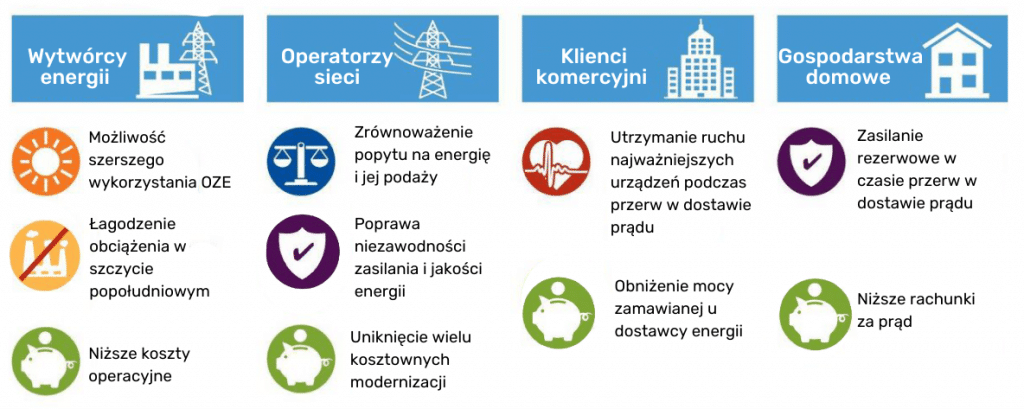
Source: Clean Energy Group
Cooperation between warehouses and power plants
Electricity storage facilities serve as a cornerstone for the shift from centralized energy generation to a distributed model. This transformation underscores their significant role in collaborating with decentralized power plants. Furthermore, diverse energy storage methods are swiftly becoming integral components of numerous energy generation systems, augmenting their efficiency and adaptability.
Yet, the role of electricity storage facilities has evolved beyond merely managing production, demand, supply, or network flexibility. These systems are now tasked with the capacity to store substantial amounts of energy over the long term. This capability becomes essential in mitigating power fluctuations that stem from the intermittent nature of renewable energy sources.
The growth of the global energy storage industry is shaped by various factors. Notably, the advancement of energy storage often goes hand in hand with the expansion of renewable energy sources like wind and solar. Consequently, many companies producing these energy storage solutions also contribute significantly to the progress of renewables. This synergy between energy storage and renewable energy plays a pivotal role in the wider adoption of clean energy sources. Simultaneously, as these sectors progress, they are paving the way for an entirely new paradigm in electricity generation and distribution.
Types of energy storage
Basic classification of energy storage
Energy storage systems can be categorized into several types, with one of the most widely used classifications distinguishing these systems:
- Mechanical
- Electric
- Electrochemical
- Chemical
- Thermal/Thermochemical
The first category of energy storage focuses on mechanical solutions, which comprise devices such as pumped-storage power plants, flywheels, diabatic compressed air tanks, and adiabatic compressed air tanks. Moving on to the second category, electric storage systems encompass capacitors and superconducting magnetic energy storage. The third category, which involves electrochemical and chemical energy storage, includes batteries, redox-flow batteries, hydrogen storage, and natural gas synthesis. Lastly, thermal and thermochemical energy storage systems, the fourth category, consist of hot water storage, steam storage, latent heat storage, and sorption/reversible binding storage.
The energy storage systems mentioned are in different stages of technical development and testing. While many of them are already available in the market, some are still in their early stages of development. Additionally, there are ongoing demonstration projects for certain systems that are just starting to become accessible.
Classification of energy storage facilities according to the design purpose
Apart from the physical classification, these electricity storage facilities can also be categorized based on their intended design purpose, which is either for large capacity or high power. In this context, the classification appears as follows:
design goal? large capacity: Hot water storage, latent heat storage, sorption/reversible bonds, pumped storage power plant, adiabatic compressed air tank, battery, redox-flow battery, hydrogen storage, and natural gas synthesis.
design goal? high power: Water vapor storage, flywheel, battery, capacitor, and superconducting magnetic energy storage.
It’s important to remember that supercapacitors and batteries, while both used for energy storage, are suited for slightly different scenarios. They also vary in their charging and discharging processes and various other parameters.
Furthermore, substantial distinctions exist among various forms of electricity storage. These variations encompass structural differences, operational modes, and the methods employed for energy storage. Additionally, the type of energy storage employed plays a pivotal role in maintaining grid frequency at suitable levels and aligning energy generation with demand. It’s also worth noting that the operational procedures of individual electricity storage systems can diverge in certain aspects. However, it’s important to recognize that the intricacies and specific characteristics of these devices often stem from their particular storage method and design.
Classification taking into account storage time
Electricity storage facilities can serve different durations of energy storage based on their technology and resulting parameters. Short- to medium-term storage systems, storing energy for several hours to a few days, utilize technologies such as battery systems, heat accumulators, certain compressed air power plants, and pumped storage power plants. In contrast, long-term energy storage spanning several days to weeks is better suited to chemical storage facilities, often based on hydrogen. It’s noteworthy that the significance of long-term energy storage is steadily increasing.
Advantages and disadvantages of energy storage
Energy storage offers several key advantages, notably in the realm of balancing voltage and frequency. Storage enables energy to be stored for extended periods, making it accessible precisely when needed. This efficient use of stored energy ensures that energy generation isn’t squandered but remains readily available. Consequently, it can be readily transferred whenever there is a demand for it, enhancing overall grid reliability and flexibility.
While electricity storage offers undeniable advantages, it’s essential to acknowledge its drawbacks, even though they are often outweighed by the benefits. One notable disadvantage is the high associated costs. Energy storage systems can also incur energy losses, and the efficiency of these processes may vary. Being aware of these limitations is crucial, even as we appreciate the substantial advantages energy storage brings to the table.
Prospects for energy storage
Our article titled “Global Energy Perspective” offers valuable insights into the future of the energy system. A report by McKinsey & Company with the same title underscores that the rapidly evolving energy subsectors are heightening the demand for efficient energy storage solutions. Consequently, we witness the emergence of new battery and electricity storage unit manufacturers, while existing producers adapt to current market dynamics. Devices designed in alignment with the latest technological trends can meet even the most stringent requirements, as evidenced by the growing number of successful production plant implementations specializing in energy storage. Additionally, the development of unconventional energy storage methods further fuels market growth.
As market demand surges, numerous conventional manufacturers are pivoting towards the production of lithium-ion batteries. However, the widespread adoption of these devices raises important safety concerns. The energy storage industry cannot afford to overlook these security issues, and as a result, any enhancements in safety measures are a gradual process. Rigorous testing of new solutions is conducted, along with continuous monitoring, both before and after their introduction to the market. This cautious approach ensures that safety remains a paramount consideration in the evolving landscape of energy storage.
Energy storage has evolved into a crucial component of power plants that harness renewable energy sources. It’s increasingly common for major corporations to incorporate storage systems into their projects. Bloomberg New Energy Finance forecasts indicate that by 2040, approximately 1,095 gigawatts of energy storage capacity will be deployed globally, spanning across various sectors from residential and commercial to industrial and public utility applications. Woods McKenzie also predicts substantial growth, estimating that the market will expand to 158 gigawatt-hours by 2024. This burgeoning growth underscores the significant investments being made worldwide to support initiatives related to energy storage.
Leave a Reply