Wind turbines – principle of operation and development
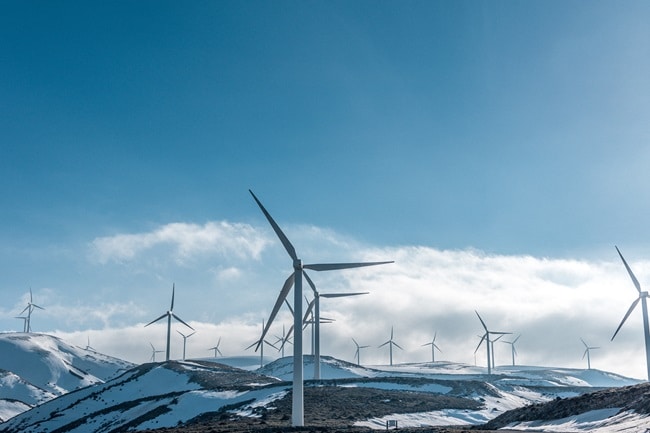
Wind turbines are assuming a growing role in the global energy landscape as they play a crucial part in the sustainable production of electricity. They work by harnessing the kinetic energy of the wind and converting it into electricity. These projects are experiencing significant growth both internationally and within Poland. Here, we outline the basic operation of wind turbines and provide insights into some of the most noteworthy projects in Poland and around the world.
Principle of operation of wind turbines
Wind turbines are apparatuses designed to transform the energy from the wind into electricity. They operate based on principles of aerodynamics and kinetics. The fundamental steps involved in the operation of wind turbines are as follows:
- Capturing wind energy: Wind turbines are equipped with blades, often resembling windmills, oriented in the direction of the wind. The force of the wind causes these blades to rotate around the axis of the turbine.
- Conversion of kinetic energy: The spinning blades transfer the kinetic energy from the wind to the turbine’s rotor. The rotor is a key component that concentrates the wind’s energy at a single point.
- Electricity generation: The turbine’s rotor is linked to a generator. This connection enables the conversion of mechanical energy into electrical energy. Inside the generator, magnets and coils work together to generate electricity as the magnets move within the coils. This process transforms mechanical energy into electrical energy.
- Transmission of electricity: The electricity produced by the wind turbine is then directed to the electricity grid, from where it can be distributed to homes, businesses, and other consumers.
Wind turbines come in various designs, sizes, and power capacities. They range from small units suitable for household use to massive wind installations with power outputs in the tens of megawatts.
Wind turbines in Poland
Wind energy plays a pivotal role in the Polish energy sector, aiding the expansion of renewable energy sources within the country. Among the notable wind projects, the Potęgowo wind farm stands out. In this article, we’ll delve into the Potęgowo project and explore other significant wind farms in Poland.
The largest wind farm in Poland – Potęgowo
The Potęgowo wind farm, launched in 2020, is a remarkable achievement in the Polish wind energy sector. It spans two regions: the West Pomeranian Voivodeship in the Malechowo commune and the Pomeranian Voivodeship in the Słupsk commune. This project is particularly impressive due to its substantial installed capacity, which amounts to 219.5 MW.
Comprising 81 wind turbines, the Potęgowo wind farm features 68 General Electric turbines with a unit power of 2.75 MW. These turbines are known for their large rotors, measuring 120 meters in diameter, and tall towers reaching 110 meters in height. Additionally, there are 13 turbines equipped with 2.5 MW GE turbines, characterized by smaller rotors, 103 meters in diameter, and shorter towers standing at 98 meters in height. The annual electricity output from this farm is approximately 360 GWh, providing power for roughly 130,000 households.
A notable aspect of the Potęgowo wind farm is its energy transmission method. The electricity generated is conveyed through two local MTS MV/110 kV transformer stations to the primary power supply points at GPZ Słupsk and KRS. The total investment for this substantial project amounted to PLN 1.25 billion. The owner of this high-capacity wind farm is the Israeli company Mashav, secured through a 15-year energy sales contract won at auction in 2018.
Other wind turbines in Poland
Certainly, Potęgowo is just one of the noteworthy wind projects in Poland. Another significant project is the Banie wind farm, located in Banie within the West Pomeranian Voivodeship. This farm comprises 53 towers equipped with Vestax V100 turbines boasting a capacity of 2.0 MW, as well as 16 turbines, each with a capacity of 3.5 MW. This totals a power output of 187.4 MW. The fourth expansion phase is currently underway, and upon completion, the farm’s overall capacity will reach 243.4 MW. Wiatromill, a subsidiary of Energix Renewable Energies from Israel, is responsible for implementing this project.
The Jasna wind farm, situated in the Pomeranian Voivodeship, is another noteworthy endeavor in Poland. It features 39 windmills, consisting of 22 Vestas V126 turbines with a capacity of 3.45 MW and 17 Vestas V126 turbines with a capacity of 3.3 MW. These turbines are optimized to operate at varying wind speeds, resulting in a combined power capacity of 132 MW. The wind farm is located in close proximity to the village of Jasna, spanning across the areas of Dzierzgoń, Stary Dzierzgoń, and Mikołajki Pomorskie.
Wind turbines in the world
The largest wind farm globally is the Gansu Wind Farm in China, situated in the Gobi Desert near the city of Jiuquan. It currently operates at approximately half of its intended capacity, capable of producing up to 20 gigawatts. While criticized for its remote location from energy-demanding cities, it still stands as the world’s most extensive installation of its kind.
In Europe, the Markbygden Wind Farm in Sweden is one of the continent’s largest wind farm complexes. It boasts a current capacity of 2 GW with plans to expand to 4 GW. This expansive farm will include over 1,100 turbines.
In the United States, the Alta Wind Energy Center in California is the largest wind farm in the country and among the world’s largest, reaching a capacity of 1.5 GW, with the potential to scale up to 3 GW. The construction cost for this facility was nearly three billion dollars, housing 600 wind turbines.
India is home to two of the world’s most substantial wind farms. The Muppandal wind farm boasts a capacity of 1.5 GW, incorporating three thousand turbines, harnessing the strong winds from the Arabian Sea. Meanwhile, the Jaisalmer Wind Park reaches a capacity of up to 1.3 GW, exclusively using Suzlon turbines with capacities ranging from 350 kW to 2.1 MW.
Onshore and offshore wind energy
The examples mentioned so far focus on onshore wind farms, but it’s crucial to highlight the rapid development of offshore wind energy in recent years.
Offshore wind energy holds substantial production potential because sea winds tend to be stronger and more consistent than those on land. This advantage allows offshore wind farms to generate significantly more electricity compared to their onshore counterparts, making them valuable contributors to addressing the escalating energy demand.
Poland is gearing up to construct its first offshore wind farm, the Baltic Power wind farm, a pivotal project by the ORLEN Group and Northland Power. This initiative seamlessly aligns with the goal of establishing a sustainable, low-emission economy. The development of renewable energy sources, particularly offshore wind energy, serves as a cornerstone of the long-term development plan. Baltic Power is positioned as one of the most advanced projects within the Polish Exclusive Economic Zone of the Baltic Sea, situated approximately 23 km north of the coast near Choczew and Łeba. The project has received authorization to build a power plant with a capacity of up to 1.2 GW, although the target capacity is set at 1,140 MW, contingent on the chosen turbine technology.
Baltic Power presently stands as the most advanced offshore wind farm construction project in the Polish part of the Baltic Sea. In 2022, the company finalized agreements for the production, transportation, and installation of all essential components required for project implementation. The initiative possesses all the necessary environmental approvals, and in early 2023, it secured the initial construction permits for the onshore aspect of the project. This marks a significant milestone, being the first permit issued for offshore wind projects in Poland. With this consent in hand, the project moves one step closer to the ultimate investment decision and the commencement of farm construction in 2024.
Wind turbines – summary
Wind energy plays a pivotal role in the worldwide shift toward more sustainable energy sources. Wind turbines are instrumental in harnessing the energy potential of wind to generate electricity. Poland, positioned as a leading player in the European wind sector, is actively engaged in the development of wind projects that bolster the presence of renewable energy sources within the national energy landscape. It’s anticipated that this sector will persist in its growth, resulting in an expansion of the number of wind turbines throughout the country over time.
Leave a Reply