The US is digging deep into its oil reserves. Experts warn of a problem that cannot be easily fixed
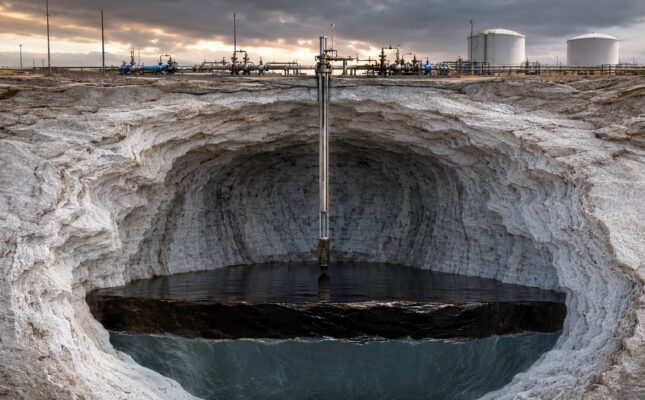
America’s strategic oil reserves are shrinking rapidly. However, the problem is not limited to the number of barrels Washington still has at its disposal. Experts warn that continued intensive withdrawals could increase the risk of damage to the vast underground salt caverns in which the United States has stored emergency oil supplies for decades.
The Strategic Petroleum Reserve, or SPR, is one of the most important components of the US energy security system. However, the oil is not kept in conventional steel tanks. It is stored deep underground in gigantic chambers carved into salt deposits in Texas and Louisiana.
It is precisely the design of these storage facilities that means very low reserve levels could become a much more serious problem than the statistics alone might suggest.
We have previously written about another use of salt caverns on our website: Could salt caverns help Poland’s energy sector?
US oil reserves have fallen sharply
In March 2026, the Donald Trump administration approved the release of 172 million barrels of oil from the SPR as part of a coordinated action by International Energy Agency member countries. Altogether, the countries participating in the operation pledged to release 400 million barrels of crude oil and petroleum products.
According to Department of Energy data, as of August 5, 2026, the US reserve still contained approximately 304.8 million barrels of oil. That is far less than the 411 million barrels held at the end of 2025. Once the exchange and release operations currently under way are completed, however, reserves could fall to around 243 million barrels. This would be the first time since 1983 that they have dropped below the 300-million-barrel threshold.
It is this level that is causing growing concern among some experts.
The 300-million-barrel threshold may matter
Siddharth Misra, a professor of petroleum engineering at Texas A&M University, said in an interview cited by CNBC that the practical lower limit for safely operating the SPR lies between 250 million and 300 million barrels. Below that range, the risk of problems increases, both in terms of cavern integrity and the efficiency of the entire oil extraction system.
This does not mean that the storage facilities will suddenly collapse once reserves fall below 300 million barrels. Rather, the system begins operating increasingly far from the conditions in which it is easiest and most predictable to manage.
There are also technical constraints. In theory, much more oil could be pumped out of the SPR, leaving around 70 million barrels. In practice, however, that level would be close to the technical minimum required for the infrastructure to function properly.
The oil is stored in gigantic salt caverns
The SPR consists of four main storage complexes located in Louisiana and Texas: Bayou Choctaw, West Hackberry, Bryan Mound and Big Hill. According to the Department of Energy, the system’s total authorized capacity currently stands at 714 million barrels.
Dozens of enormous caverns carved into salt deposits lie underground. A typical chamber can hold around 10 million barrels of oil, is approximately 60 metres in diameter and can be more than 750 metres tall. This solution has major advantages. Salt caverns are cheaper than many alternative storage methods, while salt itself has very low permeability and can naturally “seal” small cracks.
The problem emerges when large quantities of oil must be extracted rapidly.
How is the oil extracted from underground?
The mechanism is surprisingly simple. Oil floats on water, so when a cavern is being emptied, fresh water is pumped into its lower section. The rising liquid displaces the oil upward, allowing it to be directed into pipelines.
This is how the Department of Energy officially describes the process. However, there is another side to this method: fresh water dissolves salt. When caverns are emptied intensively and repeatedly, their shape can gradually change. According to Misra, particularly rapid withdrawals can flatten cavern roofs and weaken the salt pillars separating neighbouring storage chambers. Over the long term, this may increase the risk of geological problems.
The less oil remains, the harder it may be to respond quickly
Experts also draw attention to another issue. A strategic reserve is useful primarily when large quantities of oil can be supplied from it quickly during a crisis.
The SPR’s nominal maximum drawdown capacity is approximately 4.4 million barrels per day, and the oil can reach the market roughly 13 days after a presidential decision. At very low inventory levels, however, maintaining this rate may become more difficult. As the oil layer shrinks, sediment inside the caverns may also move closer to the infrastructure used to extract the oil, potentially increasing the risk of problems with pumps and pipelines.
For this reason, discussions about the SPR increasingly focus not only on the question “How much oil is left?” but also on “How much of it can actually be used quickly and safely?”
The Department of Energy offers reassurance
US authorities do not share the most alarming assessments. Department of Energy representative Ben Dietderich argued that the caverns remain full and that, as the amount of oil decreases, it is primarily the proportions of oil and water inside them that change. The administration also maintains that the SPR is managed as a key component of national security.
Not everyone is equally reassured, however. Amos Hochstein, a former energy adviser to the Joe Biden administration, warned that experts have serious doubts about whether reserves can safely be reduced to around 300 million barrels.
The dispute therefore concerns not whether the caverns can continue to be used, but how intensively they can be exploited without compromising the reliability of the entire infrastructure.
The reserve was created after the oil crisis
The Strategic Petroleum Reserve was established in the mid-1970s following the oil crisis and the OPEC embargo. The first delivery of oil entered the system in 1977. Over the following decades, the SPR was used during wars, natural disasters and severe disruptions to the energy market. It reached a record level at the end of 2009, when it held approximately 726.6 million barrels.
Today, the situation looks entirely different. If the operations under way reduce reserves to around 243 million barrels, the US will be left with a level not seen in more than four decades.
The problem may not be limited to a lack of oil
In the debate over strategic reserves, it is easy to focus on a single number. Yet the SPR’s effectiveness also depends on the condition of its caverns, pumping equipment and pipelines, as well as its ability to transport oil rapidly to refineries.
A decline to historically low inventory levels could therefore have two consequences. The US would have less oil available for the next crisis, while continued intensive use of the reserve could place an increasing strain on infrastructure built several decades ago.
There are no grounds for claiming that further oil releases will automatically cause the caverns to collapse. However, experts’ warnings show that the strategic reserve is not simply a giant tank that can be emptied and refilled indefinitely.
It is a complex geological and technical system. The lower US reserves fall, the more important it becomes to determine where its true safety limit lies.
What do shrinking US reserves mean for Poland?
Shrinking US reserves also matter to Poland. The SPR helps alleviate global oil shortages and limit sharp price increases. However, the smaller the remaining US stockpile becomes, the weaker this buffer will be during the next crisis.
This is also significant because, after moving away from Russian crude, Poland has become increasingly reliant on supplies from other regions. ORLEN currently imports oil from countries including Norway and Saudi Arabia, as well as from Africa and the Americas. Since March 2025, its refineries have no longer processed Russian oil.
The precise US share of Polish imports varies from month to month and is not published by ORLEN as a fixed figure. It is known, however, that US deliveries have become a regular part of its diversified supply portfolio. Across the EU as a whole, the United States was one of the three largest oil suppliers in 2025, accounting for approximately 12–15 percent of imports.
Poland also maintains its own emergency reserves, equivalent to at least 90 days of net imports. These reserves do not, however, protect the country from increases in global prices. Consequently, constraints on further releases from the US SPR could indirectly expose Poland to a greater risk of more expensive fuel and higher transport costs during the next global crisis.
Source: Jalopnik
Leave a Reply