Green energy in an uneven race against time. Renewable‑energy investors may end up with nothing

If you’re planning to build a photovoltaic farm above 1 MW, your project may currently be in a legally uncertain position. The issue concerns compliance with the newly adopted local spatial development plans (MPZP). As of today, general plans have been adopted in only 0.16% of municipalities in Poland — and half of them have already been challenged by the voivodeship authorities. This raises a serious question: will the new regulations block renewable‑energy investments?
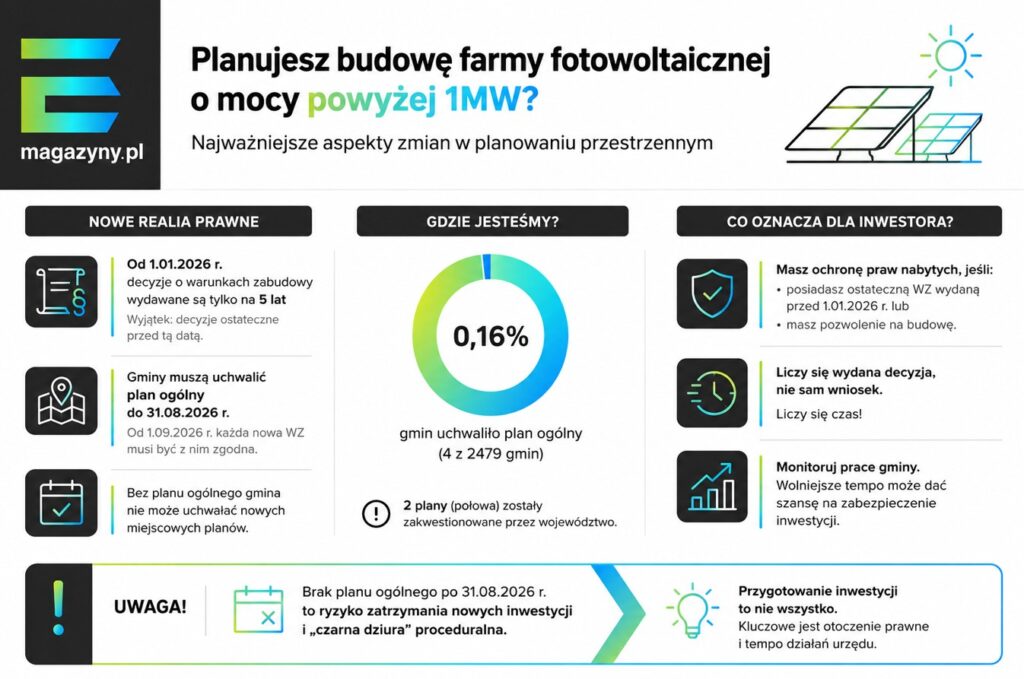
Lack of timeliness among municipalities in adopting general plans
Spatial‑planning reform is one of the most significant legal changes for the investment sector in more than a decade. It began with the amendment to the Spatial Planning and Land Development Act in 2023.
The legislator set an ambitious goal: to organize land‑use planning and limit random development based solely on zoning decisions (WZ).
The changes primarily involved replacing the previous municipal “studies of conditions and directions of spatial development” with a new document — the so‑called general plan of the municipality. This new document was intended to become the foundation for planning, defining the direction of investment development and specifying where projects could be implemented and where they would be restricted.
But that was not all. Investors also lost the legal comfort they had been accustomed to for years. Previously, once a zoning decision was obtained, it could be used even many years later. Since 1 January 2026, decisions are issued for only five years. Exceptions include documents that became final before that date or were issued in proceedings initiated before 16 October 2025 — these retain their indefinite validity.
More importantly, municipalities are obliged to adopt general plans. Currently, local governments have until 31 August 2026 to do so. From 1 September onward, every new zoning decision must comply with the general plan.
Without such a plan, a municipality cannot effectively conduct further planning activities, including adopting new local spatial‑development plans. In theory, these changes seemed logical. In practice, the task has overwhelmed many local governments.
By July 2026, only 4 municipalities out of 2,479 had adopted general plans — just 0.16%. To make matters worse, 2 of them (half) were challenged by the voivodeship authorities. The problem, however, does not stem from bad intentions, delays or negligence. Many municipalities — especially smaller ones — simply lack qualified urban planners and spatial‑planning specialists.
When a municipality does not have its own planning team, it must rely on external planning studios. On top of that comes the obligation to obtain approvals from numerous institutions, including environmental directorates, heritage conservators and Wody Polskie. With thousands of documents flowing in from across the country, multi‑month delays are inevitable.
The reform was meant to streamline the investment process. Yet right at the start — when municipalities must fulfill their planning obligations — the first bottleneck appears. This means that the success of renewable‑energy investments will depend more on the pace of municipal work than on technical preparation.
Can investments be carried out based on previous documentation?
Old municipal studies are no longer an independent basis for carrying out new investments. They outlined the development directions of a municipality, but did not grant businesses the right to implement projects.
The situation is more favorable if an investor holds a final administrative decision obtained under previous regulations. An example is an indefinite zoning decision issued before the amendment. In such a case, it serves as a basis for continuing the investment process.
The same applies to projects that have already obtained a building permit. Under the principle lex retro non agit, the spatial‑planning reform does not revoke acquired rights. This means that projects already underway may continue under the previous rules.
Investors who only planned to apply for a decision or expected to obtain one after the new regulations came into force face a much more difficult situation. In such cases, compliance of the project with the previous study no longer has practical significance. What matters is whether the municipality has adopted a general plan and whether the planned investment fits within its provisions.
The legislator’s intention was to move away from a system in which zoning decisions often replaced the actual spatial policy of local governments. The new regulations are meant to ensure that investment development stems from a previously planned strategy rather than individual administrative decisions. However, this comes with reduced investment flexibility.
What matters most for ground‑mounted renewable‑energy investors?
Investors developing large photovoltaic installations or wind farms are now in a race against time. Simply put: what counts is the issued decision, not the submitted application. Filing documents does not guarantee that the project will be assessed under previous rules. If the office does not issue a decision before the legal change, the investor may fall under the new system.
Therefore, companies should monitor municipal work on general plans. Paradoxically, slower municipal progress may benefit investors — until new documents come into force, some projects may still reach stages that secure acquired rights.
But there is another side to this. Municipalities that fail to adopt general plans by 31 August 2026 will face a very difficult situation. They will be unable to conduct further planning activities, and investors may fall into a “black hole”: no possibility of obtaining decisions, and new projects frozen until planning work is completed.
For ground‑mounted PV farms, installation capacity and land classification also matter. Under the new rules, projects above 1 MW must comply with the local spatial‑development plan. Additionally, agricultural land is subject to restrictions protecting high‑quality soils. The higher the soil class, the more difficult it becomes to obtain all required approvals. This is why planning‑document analysis should occur before purchasing land.
New spatial‑planning regulations — key differences
The new system marks a departure from the order that existed for the past two decades. Key changes include:
- replacement of municipal studies with general plans,
- establishing the general plan as the primary planning document,
- five‑year validity of new zoning decisions,
- mandatory compliance of zoning decisions with the general plan,
- restrictions on new development through “development‑completion areas”,
- limiting construction based solely on the “good neighborhood” rule,
- greater importance of approval procedures with state institutions,
- the need for investors to analyze municipal spatial policy before starting projects,
- shifting administrative‑delay risk onto investors.
Did municipal studies really expire on 30 June?
Conflicting information has appeared online regarding the expiration dates of municipal studies — 30 June and 31 August. It is worth clarifying this.
Indeed, on 30 June 2026 the period during which the previous municipal studies could be used within the spatial‑planning system came to an end. However, this does not mean that as of 1 July every municipality lost the ability to function.
The legislator introduced a transitional period related to the implementation of new general plans. The final deadline was set for 31 August 2026, and this date is now crucial for local governments.
For investors, two aspects are most important. The first is the expiration of the old planning system. The second concerns the obligation for municipalities to have a new general plan, which from September becomes the foundation for issuing decisions.
There is therefore no mistake in the dates — each refers to a different stage of the reform. Investors should not rely solely on the information about the expiration of municipal studies. What matters far more is whether a given municipality has already adopted a general plan and whether the document covers the area of the planned investment.f studies; they must check whether the municipality has adopted a general plan and whether it covers the planned investment area.
New regulations versus renewable energy
The current implementation of the reform significantly complicates the development of some renewable‑energy projects. This does not mean the reform itself is flawed — quite the opposite.
Poland needed clearer spatial‑planning rules and greater predictability. The problem is that good intentions collided with bureaucratic reality.
If most municipalities fail to adopt general plans by 1 September, investors developing long‑term, capital‑intensive projects will be hit hardest. For PV and wind farms, every month of delay increases financing costs. There is also the risk of losing grid‑connection conditions or having to repeat parts of the permitting process.
As a result, companies are competing not only on the energy market — but also with time and administrative efficiency.
In the long term, once all municipalities complete the planning process, the new system may offer greater predictability. Investors will know from the outset whether a site is designated for a specific function, avoiding months of disputes over zoning decisions.
For now, however, the renewable‑energy sector is stuck in a difficult transition period. The biggest threat is not the regulations themselves, but the pace of their implementation. If the state expects a rapid energy transition, it must create a planning system that does not slow it down. At the moment, both goals seem to be competing with each other.

Michał Krajniak
Analytical journalist who examines the energy sector through the lens of politics and economics. He describes the sector’s key challenges and closely follows emerging market trends.
Leave a Reply