Sheep, Solar Power and Science — A Model Agrivoltaic Project Emerges in Września
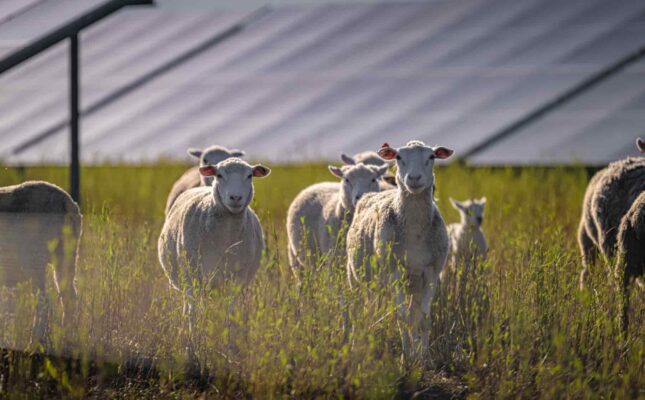
A photovoltaic farm at the Volkswagen Poznań plant in Września is becoming a showcase of how modern energy systems can coexist with agriculture and environmental protection.A flock of 100 Wielkopolska sheep has been introduced to the 18.3 MW installation, taking over vegetation management beneath more than 31,000 solar modules.
The project was delivered by Quanta Energy, which also manages the site. It is one of the largest on‑site industrial PV installations in Europe and simultaneously one of the most advanced agrivoltaic initiatives implemented alongside industrial facilities.
Natural land management under the panels
Instead of regular mechanical mowing, the farm is maintained through sheep grazing. The animals use the shade cast by the panels, which reduces heat stress during hot weather, while effectively controlling plant growth.
According to Marzena Pillich‑Grońska, director of the Volkswagen Poznań plant in Września, the farm has evolved beyond being merely a source of green energy.
– It now supports biodiversity, local agriculture, and scientific research. Sheep grazing demonstrates that modern industry can operate in harmony with nature.
Energy for the factory and environmental benefits
With a capacity of 18.3 MW, the installation is among the largest PV systems directly supplying an industrial facility. On sunny days, it can fully meet the factory’s electricity demand, and over the course of a year it provides around 25% of the plant’s energy needs.
Piotr Grzybczak, CEO of Quanta Energy, notes that the project reflects a new approach to developing energy infrastructure for industry: modern PV installations can simultaneously enhance energy security, support environmental goals, and deliver tangible benefits to the surrounding area.
Researchers evaluate agrivoltaic potential
The initiative goes beyond practical sheep grazing. In cooperation with the Poznań University of Life Sciences, researchers are studying how agrivoltaics affect animals and the environment.
Experts are analyzing animal welfare, microclimate changes, pasture quality, soil characteristics, and the functioning of the ecosystem beneath the panels.
They are assessing whether shading from the modules reduces heat stress and improves living conditions for the sheep. At the same time, they are evaluating the impact on vegetation, soil, and local microclimate to develop solutions that effectively combine energy production with agricultural activity.
A protected regional breed
The farm hosts Wielkopolska sheep, a regional breed included in Poland’s Genetic Resources Protection Program. The flock arrived at the site in late April and will remain there until autumn under the care of professional breeders.
According to Justyna Nowak‑Gajek from Owczarnia in Winna Góra, the animals adapted quickly to their new environment. They feel safe, form smaller groups, and calmly use different parts of the farm — a clear sign that they have settled well
– The sheep feel safe; they split into smaller groups and calmly make use of different parts of the farm. It’s a clear sign that they have settled in well to this environment, says the breeder.
Agrivoltaics gaining global momentum
The Września project aligns with a rapidly growing global trend of using solar farms not only for energy production but also for agricultural activity. More investors view agrivoltaics as a way to improve land‑use efficiency, enhance biodiversity, and reduce maintenance costs.
One of the best‑known examples is the Wellington Solar Farm in New South Wales, Australia. On the 174 MW site, several thousand sheep graze for most of the year, replacing mechanical mowing and reducing operational costs and emissions from heavy equipment.
In the United Kingdom, agrivoltaics have been used for years. According to Solar Energy UK, around 90% of British solar farms are also used for agriculture, most commonly as sheep pastures.
In France, advanced agrivoltaic systems are being developed by Sun’Agri, featuring movable panels that automatically adjust shading to crop needs. The technology is used in vineyards, orchards, and berry plantations, helping mitigate drought and heatwaves.
In Germany, a pioneering research project was launched in 2016 in Heggelbach (Baden‑Württemberg) by the Fraunhofer ISE institute. Under the panels, crops such as wheat, potatoes, clover, and celery are grown. Long‑term results show that combining energy production with agriculture significantly increases land‑use efficiency.
Japan is also a global leader, with more than 3,000 agrivoltaic installations where farmers grow rice, tea, ginseng, spinach, and shiitake mushrooms beneath solar panels — earning income from both food production and electricity sales.
In the United States, projects involve both grazing and crop cultivation. The InSPIRE program, supported by the U.S. Department of Energy, studies how solar installations affect agriculture, water management, biodiversity, and animal welfare. Sheep grazing is widely used as a natural land‑management method.
Against this international backdrop, the project by Volkswagen Poznań and Quanta Energy stands out for combining an industrial‑scale PV farm with the protection of a regional sheep breed and comprehensive scientific research conducted by the Poznań University of Life Sciences. It fits into global agrivoltaic trends while generating valuable data for future investments in Poland.