Costly heatwaves in Europe. What bill will this summer present to the energy sector?
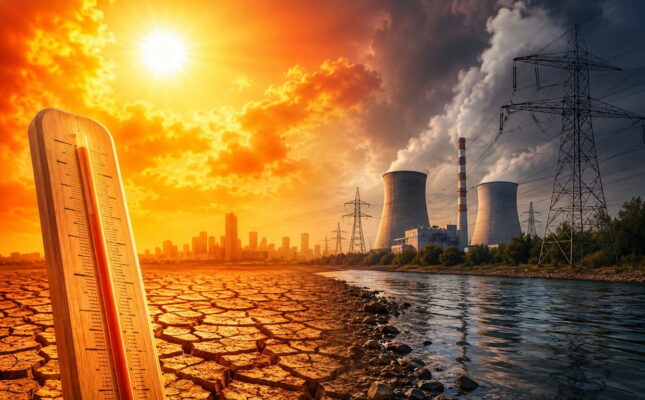
40.5°C in Słubice on Sunday, 28 June — according to measurements by the Institute of Meteorology and Water Management (IMGW‑PIB). This is the highest temperature ever recorded in Poland. A heatwave is not only evidence of climate warming and a health threat to elderly and vulnerable people, but also a real driver of rising energy prices and challenges in delivering electricity.
Poland’s climate is getting warmer — that’s a fact!
This year’s temperature record is not just a “one‑off incident.” Data from IMGW‑PIB over recent years shows a clear trend that is difficult to dismiss as coincidental. Summers increasingly bring temperatures exceeding 35°C, and in 2026, for the first time in the history of official measurements in Poland, a value above 40°C was recorded.
The highest temperatures in Poland over the last five years were:
- 36.1°C in Słubice — 20 June 2021
- 38.3°C also in Słubice — 19 June 2022
- 35.5°C in Kętrzyn — 15 August 2023
- 36.5°C in Wrocław — 10 July 2024
- 36.6°C in Kozienice — 3 July 2025
This year’s result deserves particular attention. The record was 2.2°C higher than the highest temperature from 2022. In meteorology, this is a very large difference, especially when discussing extremes.
Even more clearly, the scale of change is shown by the average temperature for all of Poland. IMGW‑PIB calculates it for the entire country and compares the results with the so‑called long‑term annual average, based on the climatological normal period 1991–2020.
According to calculations from the last five years, the average temperature in Poland was:
- 8.7°C — in 2021
- 9.5°C — in 2022
- 10.0°C — in 2023
- 10.9°C — in 2024
- 9.5°C — in 2025
Although 2025 was noticeably cooler than the record‑breaking 2024, the average temperature was still 0.8°C higher than the long‑term average for the reference period 1991–2020. This means that a year we might call “fairly normal” was still warmer than the climatic norm of previous decades.
Even more striking is the increase in average temperature from 2021 to 2024. In just three years, it rose from 8.7°C to 10.9°C, an increase of 2.2°C. Such rapid changes are not characteristic of a stable climate.
Measurement data leaves little room for debate. Poland’s climate is warming, and successive temperature records are undeniable evidence of this phenomenon. Claiming that global warming does not exist contradicts observations collected by meteorological institutions over the past 35 years.
Not only Poland is struggling with heatwaves
The current heatwave affects not only Poland. Record‑breaking temperatures are being recorded in other parts of the continent as well. From the Iberian Peninsula to the Central European Lowland, both people and the economy are suffering from extreme heat.
An example? On Sunday, 21 June, in the small town of Pissos in the Nouvelle‑Aquitaine region of France, in the Landes department, thermometers showed 42.2°C. To make matters worse, this result reflected what was happening across the entire country.
The French government took appropriate action. Nearly 800 schools were closed, and another 1,800 educational institutions changed their class schedules due to the heat. In the Paris metropolitan area, some suburban trains suspended service because rail temperatures exceeded 50°C, increasing the risk of deformation under full load. Meanwhile, the operator SNCF cancelled dozens of long‑distance trains to reduce the likelihood of air‑conditioning failures. Mathieu Lefèvre, France’s Minister for Ecological Transition, emphasized that the current heatwave is a record in terms of the geographical area of France it has covered.
Also on 21 June — Madrid — with temperatures above 40°C. That day, during the FIFA World Cup in Canada, the USA, and Mexico, Spain faced Saudi Arabia. Organizers of the fan zone in the hometown of Julio Iglesias had to cancel the public viewing event due to health risks for supporters.
Italy is also facing exceptionally difficult conditions. The highest alert level was declared in cities such as Milan, Bologna, Florence, Brescia, and Turin. The Italian Ministry of Health warned citizens about temperatures above 39°C, as they pose a threat to everyone, not just the elderly or chronically ill. To make matters worse, Italy is suffering from truly tropical nights, during which temperatures do not drop below 20°C. In practice, this makes restful, deep sleep impossible and negatively affects the body’s recovery.
While human health and life are always the most important in the context of heatwaves, it is also clear that the energy sector in European countries is suffering as well. A good example is Germany, where — according to Bloomberg — electricity prices have become the highest in nearly two years. Data from Epex Spot showed that the price of electricity for delivery rose in Germany to €545.51 per megawatt‑hour. Such high values result from a simultaneous increase in energy demand and increasingly difficult conditions for energy production.
High temperatures are a test for the power system
From a technical perspective, high temperatures pose a threat to the functioning of the power system as a whole. Coal and gas power plants struggle in summer because physics and environmental constraints remain unforgiving.
Many power units in Poland use open cooling systems supplied with water from rivers or lakes. When thermometers exceed 35°C, water in these bodies heats up significantly. Power plants cannot discharge excessively hot water back into rivers due to environmental protection — it could kill aquatic fauna. This forces a reduction in generated power. Another issue is the drop in efficiency of gas turbines. Hot air has lower density, meaning turbines draw in less oxygen and operate less efficiently.
The difficulties do not end there. Overhead power lines physically expand and stretch under high ambient temperatures and the current flowing through them. Excessive sagging of conductors risks approaching trees or the ground, causing short circuits. For this reason, the operator must limit the transmission capacity of the lines.
Transformers overheating is also worth mentioning. These devices require efficient cooling, often oil‑based. When temperatures reach 38–40°C (exactly as in recent days), heat dissipation becomes very difficult, significantly increasing the risk of failure or explosion of older transformers.
In 2026, everyone should remember the lessons of history, when heatwaves overwhelmed power systems. In Poland, during the hot August of 2015, river levels dropped drastically and water warmed so much that coal power plants lost effective cooling. The system suddenly lost nearly 2 GW of capacity. The crisis culminated in the failure of unit 14 at the Bełchatów power plant — an 858 MW block, the largest in the Polish power system.
Polskie Sieci Elektroenergetyczne (PSE) then declared Power Supply Level 20 — the most restrictive limitation on electricity consumption and delivery. More than 1,600 of the largest factories, industrial plants, and shopping centers began receiving significantly less electricity than usual. In practice, this meant that air conditioning stopped working in shopping malls, and production lines shut down in industrial halls. Thanks to this, Poland avoided a nationwide blackout.
On 30 June 2026, PSE announced a capacity market call period.
Examples can be multiplied — Europe has no shortage of them. In September 2003, a combination of energy problems occurred in two countries. Italy was massively importing electricity from Switzerland and France. Everything began with the automatic shutdown of a transit line on Swiss territory, designed to operate at temperatures up to 40°C. No surprise that when the line reached 100°C, the conductors elongated, sag exceeded 20 meters, and contact with trees caused a short circuit. As a result, around 57 million people were left without power. The overload was partly caused by long‑lasting high temperatures.
Heatwaves are costly… and not only in terms of energy
The most painful bill presented by heatwaves is paid by people. According to data from the World Health Organization, in the last four years around 200,000 people in Europe have died due to extreme heat.
Extreme temperatures increase the risk of dehydration, exhaustion, heatstroke, fainting, and respiratory problems. Negative health effects also include sunburn and chronic fatigue, often caused by sleepless nights.
Of course, the elderly, chronically ill, and children remain the most vulnerable groups. But this does not mean that healthy adults are immune to scorching heat. Heat also increases the likelihood of stroke or heart attack — and one does not need to suffer from pre‑existing conditions such as hypertension or atherosclerosis. Cardiovascular and respiratory diseases are among the negative consequences of Europe’s “African summer.”
Health costs are one side of the coin of climate warming. The other side is the functioning of energy systems, which becomes extremely challenging under such conditions.
Nuclear and hydropower also suffer
French energy giant EDF has warned that some nuclear power plants may be forced to reduce output. The reason is excessively high river temperatures used for cooling reactors.
The warning concerned plants such as Golfech, Blayais, Bugey, and Saint Alban, but the threat later extended to additional facilities along the Rhône and other rivers. France faced similar problems between 2023 and 2025. Notably, Switzerland had previously experienced almost identical issues.
Hydropower also suffers. Prolonged lack of rainfall reduces available water volumes, resulting in lower electricity production in hydroelectric plants.
Pierre‑Alexandre Ramondenc, an analyst at AlphaValue, estimated that heat‑related production constraints could increase electricity prices by around €5 per megawatt‑hour. He noted, however, that this should not lead to a permanent seasonal price increase. Such a scenario would be possible only if high temperatures forced temporary shutdowns of some power units. In that case, day‑ahead market prices could rise by tens of euros per megawatt‑hour during peak hours.
Heatwaves increase consumption, too
Heatwaves do not only cause production problems — they also increase electricity demand. In companies, factories, homes, farms, offices, and public institutions — practically everywhere — air conditioners, fans, and cooling systems operate at full capacity. The power grid becomes heavily loaded. Under such conditions, balancing the system becomes more difficult, especially when renewable‑energy production does not align with peak demand.
This is why heatwaves are increasingly seen as a threat to national energy security.
What other problems do heatwaves generate?
Photochemical smog (also known as Los Angeles‑type smog) forms under strong sunlight when pollutants in the air react with each other, creating ozone near the Earth’s surface. While the ozone layer in the upper atmosphere protects against ultraviolet radiation, ozone near the ground becomes harmful. Higher ozone concentrations cause breathing difficulties, worsen asthma symptoms, aggravate lung diseases, and increase the risk of cardiovascular conditions.
The European Environmental Bureau (EEB) has highlighted the growing problem of photochemical smog. In 2024, 77.4% of monitoring stations in the EU exceeded the allowable number of days with excessive ozone concentration. In 2025, this share rose to 85.4%.
According to the EEB, one of the most effective ways to reduce photochemical smog is to cut methane emissions. Methane promotes the formation of ozone near the Earth’s surface. The organization also calls for more ambitious methane‑reduction targets, with particular attention to agriculture — one of the main sources of CH₄ emissions.
What is causing such intense heatwaves?
Examples abound — Europe has no shortage of them. In September 2003, a combination of energy‑system failures occurred in two countries. At the time, Italy was massively importing electricity from Switzerland and France. Everything began with the automatic shutdown of a transit line on Swiss territory, which had been designed to operate at temperatures up to 40°C. It is hardly surprising that when the line reached 100°C, the conductors elongated, sag exceeded 20 meters, and contact with trees caused a short circuit. As a result, around 57 million people were left without power. The overload of the line was caused, among other factors, by long‑lasting high temperatures.
How do renewable energy sources perform during heatwaves? Up to a certain point, photovoltaics perform very well. Solar production aligns with the period of highest electricity demand. However, above 25°C, PV panels lose efficiency. Their temperature coefficient means that the hotter they get, the less energy they produce from the same amount of sunlight. It is also worth noting that heatwaves are often accompanied by flauta — a lack of wind — which practically eliminates production from wind farms.
Heatwaves are costly… and not only in terms of energy
The most painful bill presented by heatwaves is paid by people. According to data from the World Health Organization, in the last four years around 200,000 people in Europe have died due to extreme heat.
Extreme temperatures increase the risk of dehydration, exhaustion, heatstroke, fainting, and respiratory problems. Negative health effects also include sunburn and chronic fatigue, often caused by sleepless nights.
Of course, the elderly, chronically ill, and children remain the most vulnerable groups. But this does not mean that healthy adults are immune to scorching heat. Heat also increases the likelihood of stroke or heart attack — and one does not need to suffer from pre‑existing conditions such as hypertension or atherosclerosis. Cardiovascular and respiratory diseases are among the negative consequences of Europe’s “African summer.”
Health costs are one side of the coin of climate warming. The other side is the functioning of energy systems, which becomes extremely challenging under such conditions.
French energy giant EDF has warned that some nuclear power plants may be forced to reduce output. The reason is excessively high river temperatures used for cooling reactors.
The warning concerned plants such as Golfech, Blayais, Bugey, and Saint Alban, but the threat later extended to additional facilities along the Rhône and other rivers. France faced similar problems between 2023 and 2025. Notably, Switzerland had previously experienced almost identical issues.
Hydropower also suffers. Prolonged lack of rainfall reduces available water volumes, resulting in lower electricity production in hydroelectric plants.
Pierre‑Alexandre Ramondenc, an analyst at AlphaValue, estimated that heat‑related production constraints could increase electricity prices by around €5 per megawatt‑hour. He noted, however, that this should not lead to a permanent seasonal price increase. Such a scenario would be possible only if high temperatures forced temporary shutdowns of some power units. In that case, day‑ahead market prices could rise by tens of euros per megawatt‑hour during peak hours.
Heatwaves do not only cause production problems — they also increase electricity demand. In companies, factories, homes, farms, offices, and public institutions — practically everywhere — air conditioners, fans, and cooling systems operate at full capacity. The power grid becomes heavily loaded. Under such conditions, balancing the system becomes more difficult, especially when renewable‑energy production does not align with peak demand.
This is why heatwaves are increasingly seen as a threat to national energy security.
What other problems do heatwaves generate?
Photochemical smog (also known as Los Angeles‑type smog) forms under strong sunlight when pollutants in the air react with each other, creating ozone near the Earth’s surface. While the ozone layer in the upper atmosphere protects against ultraviolet radiation, ozone near the ground becomes harmful. Higher ozone concentrations cause breathing difficulties, worsen asthma symptoms, aggravate lung diseases, and increase the risk of cardiovascular conditions.
The European Environmental Bureau (EEB) has highlighted the growing problem of photochemical smog. In 2024, 77.4% of monitoring stations in the EU exceeded the allowable number of days with excessive ozone concentration. In 2025, this share rose to 85.4%.
According to the EEB, one of the most effective ways to reduce photochemical smog is to cut methane emissions. Methane promotes the formation of ozone near the Earth’s surface. The organization also calls for more ambitious methane‑reduction targets, with particular attention to agriculture — one of the main sources of CH₄ emissions.
What is causing such intense heatwaves?
The current wave of extreme temperatures is primarily driven by a heat dome. This is a large high‑pressure system that works somewhat like sealing food inside an oven. Hot air becomes trapped and cannot rise or be replaced by cooler air masses. As a result, temperatures increase day by day, and the heat can persist for weeks.
In 2026, this is the second occurrence of such a phenomenon over Europe. The first heat dome appeared at the end of May and brought record‑high temperatures to the UK, Ireland, France, and Portugal. For that time of year, the readings were exceptionally high, and the perceived temperature in some areas reached 35–40°C.
The World Meteorological Organization emphasizes that increasingly frequent heatwaves fit into the long‑term trend of climate change, confirmed by the Copernicus Climate Change Service. These institutions point out that Europe remains the fastest‑warming continent in the world, where temperature records are broken more often and across a growing geographical area.
Leave a Reply