The first mass PtX will be built in Denmark. The total capacity of hydrogen electrolysers will be 280 MW

The Danish Ministry of Energy and Climate has revealed the recipients of the inaugural tender in Denmark’s history, which aims to build a PtX installation for generating eco-friendly hydrogen. European Energy, a major player in the development of solar and wind farms across Europe, including Poland, will be the primary beneficiary of the funding. They are set to undertake three out of the six planned projects in Denmark.
In April, applications were invited for Denmark’s very first public tender, which is also one of the early ones globally, focusing on the construction of PtX installations for the production of green hydrogen. The level of interest in this tender took the ministry by surprise. The initial budget set at 1.25 billion Danish kroner, but the submitted projects from companies amounted to over 4 billion Danish kroner.
The successful companies that will receive state funding to build and operate PtX installations in Denmark are Plug Power Idomlund Denmark, European Energy/Vindtestcenter Måde K/S, European Energy/Padborg PtX ApS, Electrochaea/Biocat Roslev, and European Energy/Kassø PtX Expansion ApS.
European Energy takes (almost) everything
European Energy, a company renowned for its photovoltaic and wind farm projects, both in Denmark and Poland, is set to receive a substantial funding amount of DKK 910,800,000 in collaboration with its partners. This sum is nine times greater than the funding awarded to Plug Power Idomlund Denmark, which will be responsible for constructing the second-largest electrolyzer installation, boasting a 100 MW capacity. European Energy will take the lead on three of the six winning projects, with the largest of them featuring a 150 MW capacity, located near the Danish-German border in Padborg.
Six projects, 280 MW of total capacity
Collectively, these six projects will bring about over 280 MW of electrolysis capacity. The table provided below offers a summary of these six successful projects:
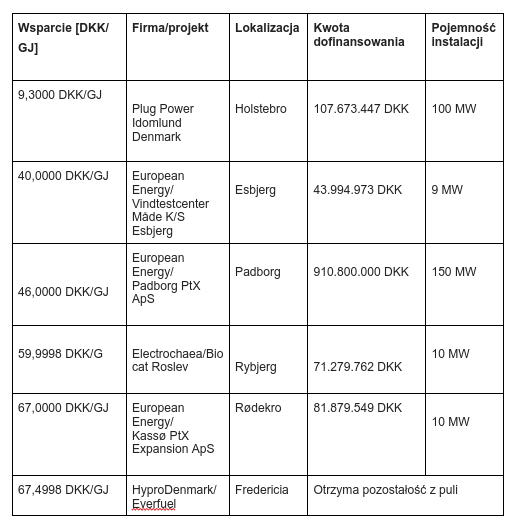
The six winning projects exhibited varying support requirements and notably different installation sizes. Plug Power’s Idomlund Denmark project stands out with the lowest support need, coming in at just DKK 9.3 per GJ for the production of green hydrogen.
“This sends a strong message that numerous projects submitted offers below DKK 70 per GJ. This is positive for market competitiveness and the transition to greener solutions,” stated Martin Hansen, Deputy Director of the Danish Energy Agency.
The support allocated to these successful projects will be provided as a fixed subsidy over a 10-year period. Companies have a four-year window to construct and launch the installations, but most of them anticipate being ready to produce green hydrogen by 2026.
Source: Danish Ministry of Climate and Energy
Read also:
PGE and GE will produce green hydrogen from an offshore wind turbine
Orlen is testing the first hydrogen locomotive in Poland
Green hydrogen in Żuławy Wiślane, production will start on a large scale
Leave a Reply