Concrete Spheres Instead of Batteries? California to Put the Idea to the Test
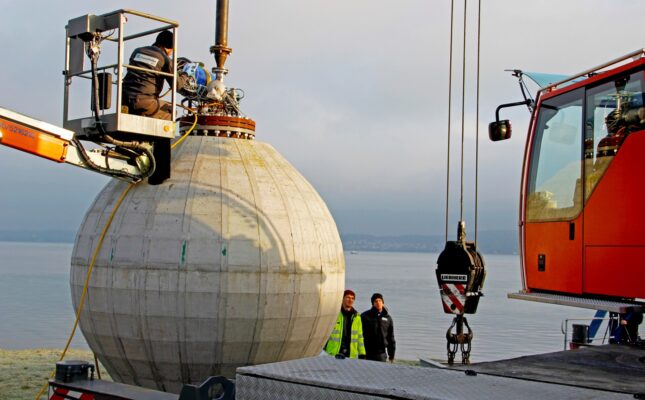
Energy storage remains one of the greatest challenges of the energy transition. Without it, it is hard to imagine stable power supply when the wind stops blowing and the sun hides behind the clouds. After years of experiments, scientists in Germany have proven that a breakthrough in this area may come from… simple concrete spheres. Now California is planning their first large-scale deployment in the waters of the Pacific.
From the Lab to the Ocean
The concept is called StEnSea (Stored Energy in the Sea) and was developed at the Fraunhofer Institute. Its foundation is surprisingly simple: spherical, hollow concrete tanks are lowered to the bottom of a body of water and anchored. Inside them is a turbine and a valve that allow water pressure to be converted into electricity.
The first tests were carried out in Lake Constance. Three-meter prototypes demonstrated that the system works: water can be pumped out and then allowed to flow back in, generating energy. The key advantage is the lack of rare metals or complex chemicals – the entire system relies on pure physics and widely available materials.
California Prototype – a 9-Meter Sphere
The next step will take place in the Pacific. As early as 2026, a nine-meter-wide sphere weighing about 400 tons will be sunk off the coast of California. It will be placed at a depth of 500–600 meters, where the water pressure will allow it to store around 0.4 MWh of energy – enough to power an average household for several weeks.
Engineers are also planning much larger structures. Versions with a 30-meter diameter would dramatically increase storage capacity and create entire underwater “battery farms,” operating similarly to offshore wind farms.
How Does It Work?
The mechanism is intuitive:
- Charging – surplus energy from the grid powers a pump that empties water from the sphere, creating a vacuum inside.
- Discharging – when electricity is needed, the valve opens, and water under high pressure flows back in, driving the turbine and generating power.
It’s the equivalent of a pumped-storage power plant – but without the need for dams and large reservoirs on land.
Advantages and Challenges
Underwater energy storage offers several key benefits:
- it uses widely available materials (concrete, water turbines),
- it can operate for decades with minimal component replacement,
- it does not occupy land space and is virtually invisible,
- it can be built in ports and towed to its final location.
This does not mean there are no challenges. Each project must take into account the impact on the marine environment, fisheries, and shipping routes. Saltwater also requires advanced corrosion protection.
Future Energy Anchored in the Ocean
If the California prototype proves successful, the technology could become highly significant for coastal regions worldwide. It would allow surplus wind and solar energy to be stored in a stable, affordable, and predictable way.
“There is no single solution that fits all. We need a mix of technologies. Concrete spheres are another piece of the puzzle,” emphasize experts from Fraunhofer IEE.
Underwater energy storage is a vision that not long ago sounded like science fiction. Today, step by step, it is diving into reality – literally at the bottom of the ocean.
Source: iee.fraunhofer.de
Leave a Reply