China has connected the world’s first compressed air energy storage facility in an artificial cavern to the grid
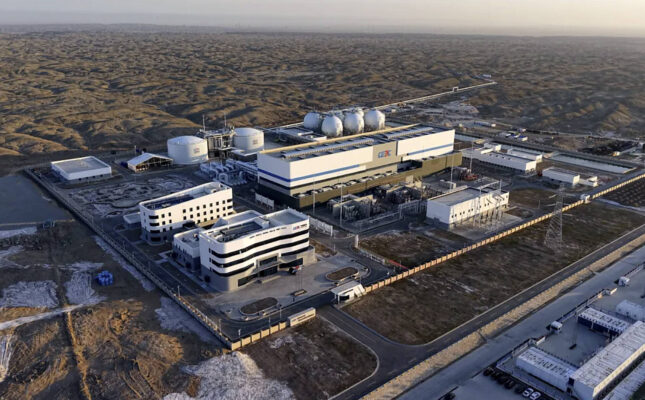
The Yuanchu No. 1 power plant has been commissioned in Yumen, Gansu Province, China. It is the world’s first grid-connected compressed air energy storage facility to use artificially excavated rock caverns. The facility has a power capacity of 300 MW and an energy storage capacity of 1.8 GWh. The project was developed by China Energy Digital Technology Group.
Artificial caverns in hard rock and pressure of 18 MPa
Until now, facilities of this type have relied on natural salt caverns. This limited their construction to regions with suitable geological conditions. In the Yuanchu No. 1 project, engineers adopted a different approach. They excavated four interconnected chambers in solid rock at a depth of approximately 110 meters. The resulting underground storage space has a volume of 200,000 cubic meters and can withstand pressures of up to 18 MPa.
The total investment amounted to approximately 2.5 billion yuan ($368 million). The facility takes eight hours to charge and can then deliver its full power output for six hours. Its estimated annual electricity generation is 600 GWh.
Molten salt thermal energy storage instead of gas combustion
The power plant operates using zero-emission adiabatic technology. During charging, compressors pump air underground, while the heat generated during compression is recovered. During discharge, the stored heat is used to warm the expanding air before it enters the turbines. This eliminates the need to burn natural gas.
The thermal system combines two heat storage media. Low- and medium-temperature heat is stored in pressurized hot water tanks, while high-temperature heat is stored in tanks containing low-melting-point molten salts. Shared heat exchangers for both cycles help reduce construction costs. The claimed round-trip efficiency is 72%, although this figure still needs to be verified through long-term operational testing.
China invests in large-scale compressed air energy storage
The facility is located in the Hexi Corridor, a region in northwestern China with a high concentration of wind and solar farms. The storage system will absorb surplus renewable electricity and feed it back into the grid during periods of peak demand.
China is rapidly expanding this technology. At least six large-scale compressed air energy storage (CAES) facilities, with capacities ranging from 100 MW to 700 MW, have already been connected to the grid, including projects in Huai’an and Jintan. Industry data indicates that another 13 projects with a combined capacity of 4.95 GW are currently under construction, while more than 36 GW of additional capacity is in the planning stages. The future success of artificial cavern technology now depends on the airtightness of the chambers and the actual operating costs of the Yumen facility.
Leave a Reply