Energy storage technologies

Climate change stands as one of the foremost challenges confronting the realms of technology and business in the present era. This predicament is underscored by notable sources such as The Global Risk Report, a publication by the World Economic Forum. According to the insights presented in this report, steering clear of the dire consequences of global warming necessitates a concerted effort toward achieving climate neutrality. As a result, the prevailing circumstances demand a shift in the approach to electricity generation, entailing a departure from conventional fossil fuels in favor of fostering the advancement of renewable energy sources (RES).
In light of ongoing events and comprehensive analyses, it becomes unmistakably evident that the global count of renewable energy source (RES) installations is on an upward trajectory. Concurrently, the rapid evolution of RES, coupled with their inherent variability, presents an additional challenge for the industry. As the world progressively embraces green energy on a larger scale, the imperative to balance power grids and advance energy storage technologies becomes increasingly pronounced. Drawing from insights gleaned from the report titled “Available and Future Forms of Energy Storage” by the WWF Polska Foundation, I will elucidate promising solutions that are either under development or already operational, contributing to the construction of a climate-neutral energy mix.
Known and developed methods of energy storage
The surging demand for energy is driving the emergence of novel technological solutions within the realm of energy storage. Simultaneously, it is fostering the enhancement and refinement of pre-existing solutions.
Technologies based on mechanical transformations
Pumped-storage water power plants (PHS) fall under the category of mechanical energy storage methods and are among the most prominent large-scale energy storage techniques. These installations consist of two reservoirs positioned at different elevations. The operational principle is straightforward: electric pumps transfer water from the lower reservoir to the upper one, thereby storing energy. Subsequently, the release of water from the upper reservoir through turbines linked to generators yields electricity that can be fed back into the grid.
The notable advantages of PHS include an efficiency of around 85%, minimal energy losses during storage, a high power density, and a lifespan exceeding 20 years. In Poland, there are three pumped-storage power plants constructed in the 1970s (Żarnowiec, Żydowo, Porąbka-Żar), along with three run-of-the-river power plants that incorporate water pumping capabilities (Solina, Niedzica, Dychów). All of these facilities play a crucial role in stabilizing the national power system (NPS).
Compressed air energy storage (CAES) harnesses surplus energy from renewable sources during periods of high generation to compress air and stockpile it in cavernous tanks, like rock caverns, salt formations, or deep mines. Consequently, when electricity demand increases, the compressed air is utilized to generate power through expansion in turbines.
Similar to pumped-storage power plants, compressed air installations can be implemented on a large scale. Furthermore, they are designed to store energy over time spans ranging from several hours to several months, exhibiting a robust durability of 20 to 40 years. The overall efficiency of the storage cycle varies between 42% to 54%. These facilities are instrumental in stabilizing power systems and mitigating significant fluctuations in energy prices.
Liquid air energy storage (LAES) is an intriguing technological innovation that builds upon the concept of compressed air energy storage. This method employs electricity to refrigerate and condense air into a liquid state, which is then stored within sizable cryogenic tanks. Upon discharge, the liquefied air is vaporized, heated, and channeled through a gas turbine, ultimately generating electricity.
The fundamental principle of LAES revolves around large-scale energy storage for medium to long durations. However, due to its relatively higher cost compared to other methods, it may not be the most suitable choice for seasonal energy storage.
Technologies based on electromechanical transformations
Electrochemical methods constitute the second prominent group of energy storage techniques, recognized well in Poland. This category encompasses galvanic cells, such as lead-acid batteries, lithium-ion batteries, and redox batteries.
Lead-acid (PbA) batteries were among the earliest forms of energy storage technology. They exhibit an efficiency range of 75% to 85%. However, due to their limited lifespan and modest energy density, they have seen a decrease in popularity compared to lithium-ion batteries.
Lithium-ion (Li-ion) batteries have achieved remarkable popularity, finding widespread use in diverse applications like cars, smartphones, laptops, and various electronic devices. Their dominance in the global battery market exceeds 90%.
Lithium-ion energy storage systems serve as emergency power sources, boasting exceptional lightweight properties and a high energy density when compared to other battery types. Their efficiency stands at approximately 98%. Ongoing innovations target enhancing the competitiveness of these batteries for long-term energy storage.
Nevertheless, it’s important to acknowledge a few drawbacks associated with lithium-ion technology. One significant concern is the challenge of managing used cells. Fortunately, an increasing number of companies are exploring recycling options for these cells, and efforts are underway, including the establishment of a battery recycling plant in Zawiercie, Poland. Limited lithium resources pose another concern. Nonetheless, scientists propose a potential resurgence of ion technology through the application of sodium.
Sodium-ion (Na-ion) batteries offer promise as a potential alternative to lithium-ion batteries. Leading lithium-ion cell manufacturer CATL is presently working on the industrial production of sodium-ion cells. According to the manufacturer, sodium-ion cells demonstrate competitiveness in terms of charging speed, integration efficiency, and performance at low temperatures. Furthermore, sodium is more cost-effective and available compared to lithium.
Sodium-sulphur (NaS) batteries represent another technology with the potential to revolutionize the energy storage sector, eliminating the need for lithium.
Flow batteries are a notable alternative in applications necessitating extended energy storage durations and continuous power supply. These batteries feature a relatively low energy density and a lengthy life cycle. They store energy in two liquid chemical solutions, which flow through an electrochemical cell on either side of a specialized membrane during discharge. The membrane separates the substances while permitting ion exchange between them, facilitating the conversion of chemical energy into electrical energy.
Among flow batteries, the most prevalent type employs redox reactions, and within this category, vanadium redox flow batteries are particularly popular due to cost and environmental considerations.
Research indicates that these batteries exhibit longevity, robustness, low operational expenses, and minimal environmental impact. Vanadium redox flow batteries also present a lower cost of ownership and a consistent cost of energy storage throughout their lifespan, albeit the initial purchase cost tends to be higher than that of lithium-ion batteries.
Technologies based on electrical transformations
Supercapacitors represent a distinct class of capacitors that deviate from the conventional design, employing a single conductive plate in lieu of the customary two plates separated by a dielectric (insulating material). Instead, one plate interfaces with an electrolyte. In these systems, the separation of charges transpires within a dual electrical layer positioned on the surface of the charged electrode, which is immersed in the electrolyte.
These devices excel at rapid charging and discharging, characterized by high power output. However, their drawback lies in their comparatively limited capacity. Consequently, they find their primary application as short-term energy reservoirs, exhibiting rapid response times in the millisecond range. This functionality contributes to bolstering power supply quality, offering defense against momentary power disruptions, voltage fluctuations, or frequency variations. Supercapacitors exhibit impressive efficiency, reaching levels of up to 97%.
Beyond their role in power enhancement, supercapacitors also serve as stationary energy storage solutions or as complementary technologies. For instance, in electric vehicle propulsion systems, they complement lithium-ion batteries, contributing to an extended battery lifespan and overall performance.
Technologies based on chemical changes
Hydrogen fuel cells represent a promising avenue for electricity generation through the chemical reaction between hydrogen and oxygen. This technology stands out as progressive and brimming with potential, primarily due to its capacity to operate without emitting greenhouse gases. Although free hydrogen doesn’t naturally occur on Earth and must be produced using energy, various methods exist for its production, including two emission-free approaches: water electrolysis and catalytic water splitting.
While fuel cell technology, particularly hydrogen-based systems, has yet to achieve widespread adoption, it holds considerable promise due to its numerous advantages over traditional electrochemical technologies. One of its standout features is the avoidance of reliance on rare raw materials, positioning it as an environmentally friendly solution. Moreover, the only byproduct of hydrogen combustion is water vapor. Furthermore, this process can be reversed, enabling energy storage capabilities. Additionally, hydrogen fuel cells excel in terms of replenishment time compared to traditional battery charging. At present, ongoing research and development endeavors aim to propel the popularization of hydrogen fuel cell technology.
Choosing the best energy storage methods
Indeed, the landscape of energy storage solutions is marked by a range of advantages and disadvantages, underscoring the complexity of selecting the most effective method or a blend of methods. The diversity of applications and economic considerations contributes to the coexistence of various technologies, rather than the dominance of a single one. For instance, traditional pumped storage power plants often exhibit cost advantages over innovative hydrogen storage, yet the feasibility of constructing the former is contingent on specific conditions.
The optimal choice of energy storage methods is also heavily context-dependent. Factors such as expectations, needs, desired functionalities (e.g., long-term or mobile storage), intended purposes, geographic locations, and costs all come into play when making decisions. In light of these variables, hybrid energy storage solutions may offer the most suitable resolution in many scenarios. By amalgamating two or more different technologies, a more cost-effective option can often be achieved. Additionally, this approach can address the shortcomings or limitations of a single-technology energy storage setup.
Prospects for the development of energy storage
The energy storage market is poised for significant growth, as indicated by various forecasts. Until recently, energy storage primarily served as an emergency power source or a solution for addressing outages. However, the current focus has shifted towards finding ways to address challenges in the power system, especially in light of the proliferation of renewable energy sources. With the evident technical advancements, economic incentives, and environmental benefits associated with energy storage systems, there’s little doubt that investments in these solutions will escalate.
In the aforementioned article, I’ve highlighted several widely-discussed energy storage methods. Nonetheless, there exists a plethora of other methods, and ongoing research and development may unveil further innovations. Predicting which of these solutions will take root in the Polish energy sector remains uncertain. Presently, Poland predominantly employs three energy storage methods on a larger scale: mechanical, electrochemical, and thermal. Globally, lithium-ion battery technology is advancing rapidly, and the same holds true in Poland, where several high-power pilot projects are currently underway. According to WWF projections, lithium-ion cells will account for over 1.2 TWh of global capacity by 2028, encompassing segments such as electric vehicles, electronics, and stationary energy storage. Additionally, keeping an eye on fuel cell technology, particularly hydrogen cells, is recommended. These cells capitalize on readily available raw materials for energy production and are deemed competitive due to their environmental friendliness and shorter charging times, as compared to traditional galvanic cells.
Expert comments
Certainly, including expert perspectives on the development of energy storage technology can provide valuable insights and a well-rounded conclusion to the article. Expert opinions offer real-world insights into the industry’s trends, challenges, and future prospects, adding credibility and depth to the content. By incorporating these professional insights, readers can gain a comprehensive understanding of the current state and future trajectory of energy storage technology.
- Krzysztof Wybrański, director of new technologies development at ZPUE SA:

Krzysztof Wybrański, director of new technologies development at ZPUE SA
“It is not possible to further develop RES and change the energy mix without the development of energy storage technology. Energy storage will allow us to shift the generation profile in relation to the consumption profile today they have to balance in real-time.
Currently, technology allows us to convert electrical energy into kinetic energy and store it in electrochemical cells. Depending on the time and amount of energy that we want to store, we use different storage tanks. Today, engineers from various industries are working very intensively on various energy storage technologies. I think that in the near future, we will have many interesting solutions in the field of energy storage”.
- Artur Koziński, manager of the SPS development department at ZPUE SA:
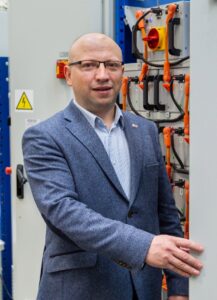
Artur Koziński, manager of the SPS development department at ZPUE SA
“Currently, we are at such a stage of energy transformation that we are moving away from emission sources based on the combustion of hydrocarbons, and we are switching to renewable ones (RES). The characteristics of their work differ significantly from the operation of heat sources and are inextricably linked to the prevailing weather conditions. Sources with such unstable generation characteristics, working individually, are not suitable for directly supplying electricity receivers. The electricity generated in this way must be properly processed and stabilized to make it usable by receivers.
The integration of renewable energy sources into the existing energy grid, where controlled thermal sources still play a significant role, presents challenges in maintaining energy quality and ensuring grid stability. With renewables accounting for about 15% of the energy mix, issues such as maintaining grid stability and avoiding blackouts become more pronounced. As the energy sector continues to shift towards greater reliance on renewable sources, these challenges will intensify. Energy storage emerges as a crucial solution to address these issues.
Energy storage systems offer the ability to manage surplus energy generated from renewables during times of overproduction and release stored energy back into the grid during periods of scarcity. By strategically combining different types of renewable sources with varying generation profiles and energy storage technologies, the power system can achieve stable and secure operation, even with renewables taking on a dominant role. Without the integration of energy storage, the further expansion of renewable energy capacity becomes increasingly difficult, if not impossible, due to the strain it places on existing grids that lack the capacity to balance the variable energy output from renewables.
In essence, energy storage technologies are essential to enable the continued development and integration of renewable energy sources. They ensure that the power system can effectively manage the fluctuations in energy generation from renewables and maintain stability. Various energy storage methods are being explored, but those that can facilitate the daily balancing of energy from renewables hold particular significance in addressing the challenges of grid integration and energy security. As the energy landscape evolves, energy storage solutions become a critical tool for supporting the growth and sustainability of renewable energy development”.
Sources:
Available and future forms of energy storage, Report of the WWF Polska Foundation, Warsaw 2020.
The Global Risks Report 2022 17th Edition, World Economic Forum, 2022.
The 5 Most Promising Long-Duration Storage Technologies Left Standing, www.greentechmedia.com (accessed: 30/03/2023)
CATL Unveils Its Latest Breakthrough Technology by Releasing Its First Generation of Sodium-ion Batteries, www.catl.com (accessed March 30, 2023)
Can flow batteries supercharge the energy transition? , www.energymonitor.ai (access: 30/03/2023)
Leave a Reply