A tank in the sea instead of batteries on land. How do Italians plan to tackle electricity shortages?
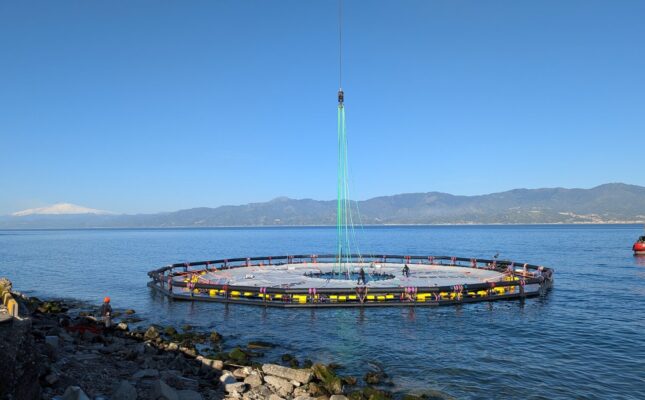
Sizable Energy is developing a pioneering long-duration energy storage system that uses gravity, seawater, and tanks filled with dense brine instead of expensive lithium-ion batteries. The solution is a marine adaptation of the well-established pumped-storage hydropower concept, but eliminates the need for significant differences in terrain elevation.
From pool testing to commercial projects in Italy
The project is led by Simone Biondi, co-founder of Sizable Energy, who confirms that the research and development phase and concept validation have been completed. Following rigorous testing at the Dutch maritime research institute Marin and offshore trials near Reggio Calabria conducted in cooperation with a local university, the technology has demonstrated its reliability under real-world conditions. Importantly, installation operations can be carried out without specialized, expensive vessels.
How exactly does the new technology work? When the grid has a surplus of cheap renewable energy, pumps transfer brine from a flexible reservoir resting on the seabed to a floating tank at the surface. When electricity demand increases, the process is reversed. The liquid flows downward under gravity through a turbine, generating a steady supply of electricity. The entire system operates in a closed loop, requires no land, and relies on widely available materials.
The promising results have attracted the attention of the European Commission, which awarded the startup the prestigious STEP Seal certification. This secured additional funding for the construction of an integrated demonstrator connected to a data center in Naples, scheduled to become operational in the first half of 2027. Meanwhile, advanced engineering work is underway at the pre-FEED and FEED stages for two commercial projects – in Calabria and Sicily. Sizable Energy has already built an international project portfolio with a potential capacity exceeding 10 GWh, spanning the Mediterranean, the Middle East, and the Caribbean.
Combining offshore energy storage with solar power and data centers
Offshore gravity-based energy storage systems have been designed to work in full synergy with floating solar installations and offshore wind farms. The concept, known as Power Shell, enables offshore solar infrastructure, energy storage systems, and data centers to be directly integrated into a single shared platform. Such a configuration addresses the challenge of ensuring an uninterrupted power supply to facilities with critical electricity needs, such as server rooms requiring power 24 hours a day.
A key advantage of the technology is its full scalability, allowing storage power and capacity to be adjusted independently. Power output depends on the depth of the reservoir and the number of installed machines, while storage capacity increases with the volume of the tanks themselves. As a result, the cost of energy storage scales linearly with volume rather than with the number of chemical battery cells. The estimated lifespan of the installation exceeds 30 years, without the capacity degradation associated with conventional batteries.
A new standard for large-scale investments and grid congestion relief
Sizable Energy does not view lithium-ion batteries as direct competitors, but rather as a complementary technology. While conventional battery energy storage systems (BESS) are well suited to rapid frequency regulation, the offshore gravity-based system targets the large-scale energy storage market, with projects measured in gigawatt-hours. It provides reserve, balancing, and synthetic inertia services.
An essential requirement for deploying the technology is access to waters at least 500 meters deep, located within a reasonable distance of the coast and electricity transmission infrastructure. In Italy, such initiatives could benefit from market mechanisms operated by transmission system operator Terna, which guarantee long-term contracts for capacity availability. An alternative or complementary approach involves direct green energy supply agreements with major technology companies.
Investing in offshore energy storage also reduces the grid connection costs of offshore wind farms by allowing excess electricity to be stored when transmission cables reach their maximum capacity.
Leave a Reply