World’s largest liquid air energy storage facility begins operation in China: 60 MW and 10 hours of operation
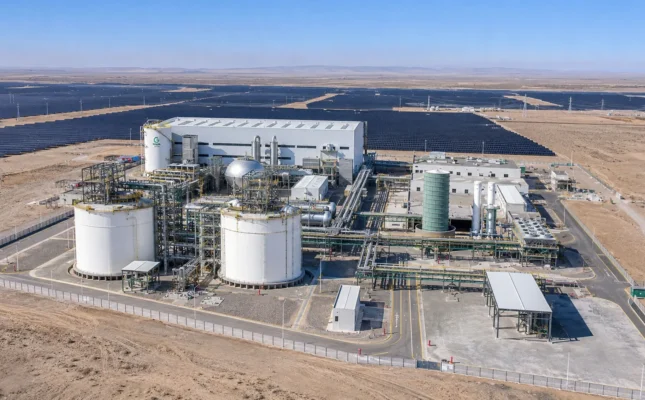
The world’s largest commercial liquid air energy storage facility has officially been connected to the grid and commissioned in China’s Qinghai province. The facility in Golmud has a power output of 60 MW and a storage capacity of 600 MWh, enabling it to supply electricity continuously for 10 hours. The project was developed by the state-owned China Green Development Investment Group in cooperation with the Chinese Academy of Sciences.
How does air liquefaction work? Operating principles of the facility
The LAES system uses ambient air as its working fluid. Its construction requires neither lithium-ion batteries nor underground salt caverns, providing considerable flexibility in terms of location.
The process consists of two cycles:
- Charging phase – surplus low-cost electricity from renewable energy sources powers compressors that compress purified air to a pressure of approximately 7 MPa. The heat generated during compression is recovered and stored as hot water at temperatures of up to 195°C. The air is then cooled and liquefied at -194°C before being transferred to insulated cryogenic tanks.
- Discharging phase – the liquid air is pressurized, evaporated and heated using the previously stored thermal energy. The expanding gas drives turbines that generate electricity, while the recovered cold energy is returned to the system for use in the next cycle.
According to estimates, the facility in the Qaidam Basin can absorb approximately 600 MWh of surplus renewable energy per day. As a result, it is expected to supply around 180 GWh of electricity to the grid annually (equivalent to the electricity needs of approximately 30,000 households).
Complete technological independence and grid inertia
Construction of the facility began in July 2023. The project was designated a national technology demonstration project and included on the list of key innovations recognized by China’s National Energy Administration.
All major components – including large-scale centrifugal compressors, liquid expanders and cryogenic heat exchangers – were manufactured in China (achieving 100% localization of the supply chain). An additional advantage of LAES technology is that its rotating turbines provide rotational inertia that helps stabilize the power grid. This supports grid balancing as large amounts of solar and wind power generation capacity are integrated into the electricity system.
Leave a Reply