Europe prepares its power grid for a solar eclipse. Spain faces the biggest test
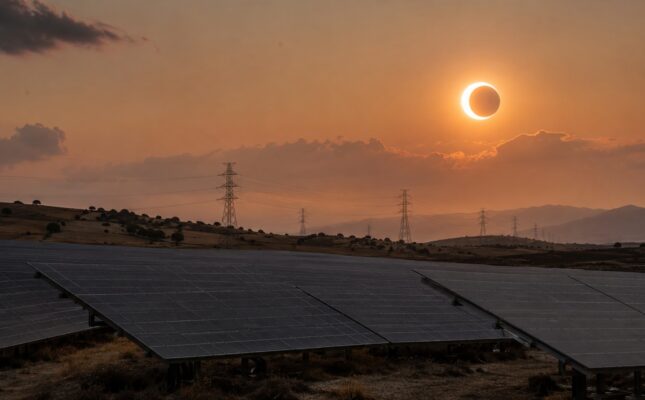
European power grid operators are preparing for the solar eclipse on 12 August. The reason is simple: as the Sun disappears, electricity generation from solar panels will fall sharply. The European Commission says the risk of disruption is low, but in countries such as Spain, the event will be an unusual test for the power system.
The impact will be less pronounced in Poland. The eclipse will occur in the evening, when solar power generation is already declining rapidly.
A rare spectacle over Europe
On the evening of Wednesday, 12 August 2026, the Moon will completely cover the Sun over part of Europe. The path of totality will cross Greenland, Iceland, northern Spain and a small part of Portugal before reaching the Mediterranean Sea. For Spain, it will be the first total solar eclipse visible from the country’s mainland in more than a century. The eclipse will peak there in the evening, shortly before sunset, when the Sun will be just a few degrees above the horizon. Viewing conditions will be more favourable in Iceland, where the eclipse will peak earlier and the Sun will be about 25 degrees above the horizon.
What will we see in Poland on 12 August?
Poland will lie outside the path of totality, but the spectacle will still be impressive: in the western part of the country, the Moon will cover as much as 85–88 per cent of the Sun’s disc, and the Sun will set while still partially eclipsed. The greatest obscuration—up to 88 per cent—is forecast for the Kłodzko Valley, with a slightly smaller proportion in Masuria. Depending on the location, the eclipse will begin between 7:10 pm and 7:20 pm.
Another attraction that evening will be the peak of the Perseid meteor shower: once the Sun has set, the sky will put on another show.
When the Sun disappears, solar power generation falls sharply
What was once merely an astronomical curiosity now has an entirely different significance. In 1999, when Europe witnessed the previous total eclipse, solar power was virtually non-existent. Today, solar power is one of the pillars of Europe’s energy mix—which is precisely why the solar eclipse has become the subject of serious analysis at EU level.
The European Commission has announced that European transmission system operators will monitor whether the eclipse destabilises the electricity supply. The risk is described as low but real, particularly in countries where solar power accounts for a large share of electricity generation.
A lesson from Texas
The scale of the potential problem is well illustrated by analyses conducted ahead of a similar eclipse that crossed the United States in April 2024. Before that event, power grid operators in Texas—a state heavily reliant on large-scale photovoltaic installations—estimated that it could lose as much as approximately 17 gigawatt-hours of energy because the eclipse was expected to coincide with the daily peak in solar generation.
According to those forecasts, power output was expected to change much faster during the eclipse than during a natural sunrise or sunset, falling at a rate of around 250 megawatts per minute. In areas at the very centre of the path of totality, solar generation was expected to be almost completely cut off for several minutes, while disruption to the electricity generation profile was expected to last for about an hour and a half. These pre-event analyses demonstrate how seriously grid operators in countries with a high share of solar power now take eclipses—and why similar preparations are currently under way in Europe.
Will Poland experience power shortages during the eclipse?
There is, however, an important detail that reduces the risk for Poland and most of Central Europe: the eclipse will occur shortly before the Sun naturally sets, when electricity generation from solar panels already falls sharply every evening. This is entirely different from the situation in Texas in 2024, where the eclipse occurred precisely at the peak of daily solar generation.
Earlier observations in Poland support this conclusion. Analyses conducted by scientists from a photovoltaic laboratory in Kraków during the 2015 eclipse showed that the decline in solar irradiance and the associated reduction in PV system output could be compared to the effect of normal, fairly heavy cloud cover typical of that time of year—not to a sudden, uncontrolled failure.
What does this mean in practice?
For the average electricity consumer, the eclipse on 12 August will most likely pass entirely unnoticed. Grid operators have experience balancing such fluctuations, and the timing of the event happens to favour system stability. The real test will be in Spain, which lies directly in the path of totality and is also among the European countries with the highest share of solar power. It is there that European grid operators and energy analysts will be watching events most closely.
The solar eclipse on 12 August 2026 is therefore more than just a rare astronomical spectacle. It is also an unusual test for Europe’s power system, in which solar energy now plays a vastly greater role than it did during eclipses two decades ago.
Leave a Reply